

If you run a shop, supermarket or wholesale in Kenya, eTIMS in 2026 is no longer a box you tick once. It now decides which of your costs KRA will accept when you file.
Since 1 January 2026, iTax checks the income and expenses in your return against eTIMS invoice data. The Finance Act 2026 rewrote the penalty for not using electronic tax systems. And in September, KRA told every eTIMS user to keep stock records in the system. Here is what changed, what the eTIMS penalties are now, and what your POS has to do. This is a plain guide, not tax advice, so confirm your own position with KRA or your tax adviser.
eTIMS 2026 at a glance
| Date | What changed |
|---|---|
| 28 Mar 2024 | The Tax Procedures (Electronic Tax Invoice) Regulations, 2024 take effect. Everyone carrying on business must issue electronic tax invoices, VAT-registered or not, and keep stock-in and stock-out records in the system. |
| 1 Jan 2026 | iTax starts validating income and expenses in returns against eTIMS invoices, withholding tax records and customs import data (KRA notice of 10 November 2025). |
| 8 Jun 2026 | KRA allows expenses without eTIMS invoices for the 2025 year of income only. From the 2026 year of income, declared income and expenses must be backed by eTIMS/TIMS invoices. |
| 1 Jul 2026 | The Finance Act 2026 replaces the penalty for failing to use electronic tax systems. |
| 7 Sep 2026 | KRA public notice: keep accurate, up-to-date stock records in TIMS/eTIMS. Consultative forums with businesses follow. |
| 30 Jun 2027 | Filing deadline for 2026 income tax returns for a December year end, the first year fully checked against eTIMS. |
The eTIMS deadline that matters has already started
Many owners are waiting for “the eTIMS deadline”. In practice, it began on 1 January 2026. KRA’s notice of 8 June 2026, reported by Kenyans.co.ke, let taxpayers declare genuine expenses without eTIMS invoices one last time, for the 2025 year of income. From the 2026 year of income, every declared income and expense line must be supported by a valid electronic tax invoice.
So every stock purchase, repair or service you pay for this year without an eTIMS invoice is a cost you may not be able to claim. If your year ends in December, that return is due by 30 June 2027, and iTax will compare it against what your suppliers transmitted.
Khusoko gives a simple example. A business claims KES 500,000 in repairs, but only KES 100,000 traces to eTIMS. The other KES 400,000 is disallowed and added to taxable income. It also notes that if a supplier does not capture the buyer’s PIN on the eTIMS invoice, that expense is disallowed in the 2026 filing. Check your supplier invoices now, not in June.
eTIMS penalties in 2026
1. Disallowed expenses. Under the Finance Act 2023, an expense is not deductible unless it is supported by an eTIMS or TIMS invoice, apart from exempt items such as salaries under PAYE, imports, interest and airline tickets (EY, KPMG). Any genuine cost without a valid invoice is taxed as if it were profit.
2. The electronic tax system penalty. The Finance Bill 2026 proposed twice the tax due. Parliament reduced it. According to PwC and EY, failing to comply with electronic tax systems now attracts the higher of:
- 5% of the tax due, or
- KES 100,000 for a company, or
- KES 10,000 for an individual.
Note the floor: for a small company, one failure can cost KES 100,000 even when little tax is involved. There is some protection. Before imposing the penalty, the Commissioner must consider whether the failure was beyond your control and whether you took reasonable steps to comply as soon as possible. The Commissioner can also waive penalties and interest of up to KES 2 million where they arose from an error generated by an electronic tax system. Keeping records that show what your system sent, and when, is how you prove reasonable steps.
New in 2026: KRA wants your stock records in eTIMS
On 7 September 2026, KRA published a public notice asking all businesses that use TIMS or eTIMS to keep accurate, up-to-date stock records: goods purchased or received, sold, transferred, returned, adjusted or otherwise disposed of. Tech-ish points out the duty is not new. Regulation 4(3)(c) of the 2024 regulations already says users must maintain stock-in and stock-out records in the system.
The notice gives no deadline and no penalty, and KRA is holding consultative forums first. But the direction is clear. As Techweez explains, KRA will be able to compare what you bought, what you sold and what is left. A gap is not automatically wrongdoing, but an unexplained one invites questions. If your stock still lives in an exercise book, now is the time to move it into a proper inventory management system.
What your POS must do in 2026
| Your POS should | Why it matters in 2026 |
|---|---|
| Issue and transmit an eTIMS invoice on every sale, automatically | Missing invoices trigger the electronic tax penalty, and your customers cannot claim the cost. |
| Capture the buyer’s KRA PIN on business sales | Without it, your business customers lose the deduction and may buy elsewhere. |
| Keep selling when the internet drops, then resend | Outages happen. Queued invoices protect you from gaps. |
| Show you which invoices KRA has not confirmed | You cannot fix what you cannot see. This is also your evidence of reasonable steps. |
| Record every stock movement | Purchases, sales, returns, transfers, adjustments and write-offs, as the KRA notice lists them. |
| Tie purchases to supplier invoices | Each delivery should be recorded against the supplier’s invoice number, so the cost is traceable when you file. |
| Keep records you can produce later | KRA can ask for supporting records. Keep them for at least five years, backed up. |
Also pick the right eTIMS route. According to HapaKenya, eTIMS Lite (USSD *222# or the mobile app) suits individuals and sole proprietors, the eTIMS Client is a desktop application, and OSCU and VSCU integrate with a POS or ERP for busier businesses. A busy counter needs the integrated route. Our earlier guides explain OSCU vs VSCU and why you rarely need a separate eTIMS device.
How RetailPulse handles eTIMS in 2026
RetailPulse is our POS system and business management software for Kenyan shops, supermarkets, wholesalers, bars and butcheries. Here is how it lines up with the checklist above.
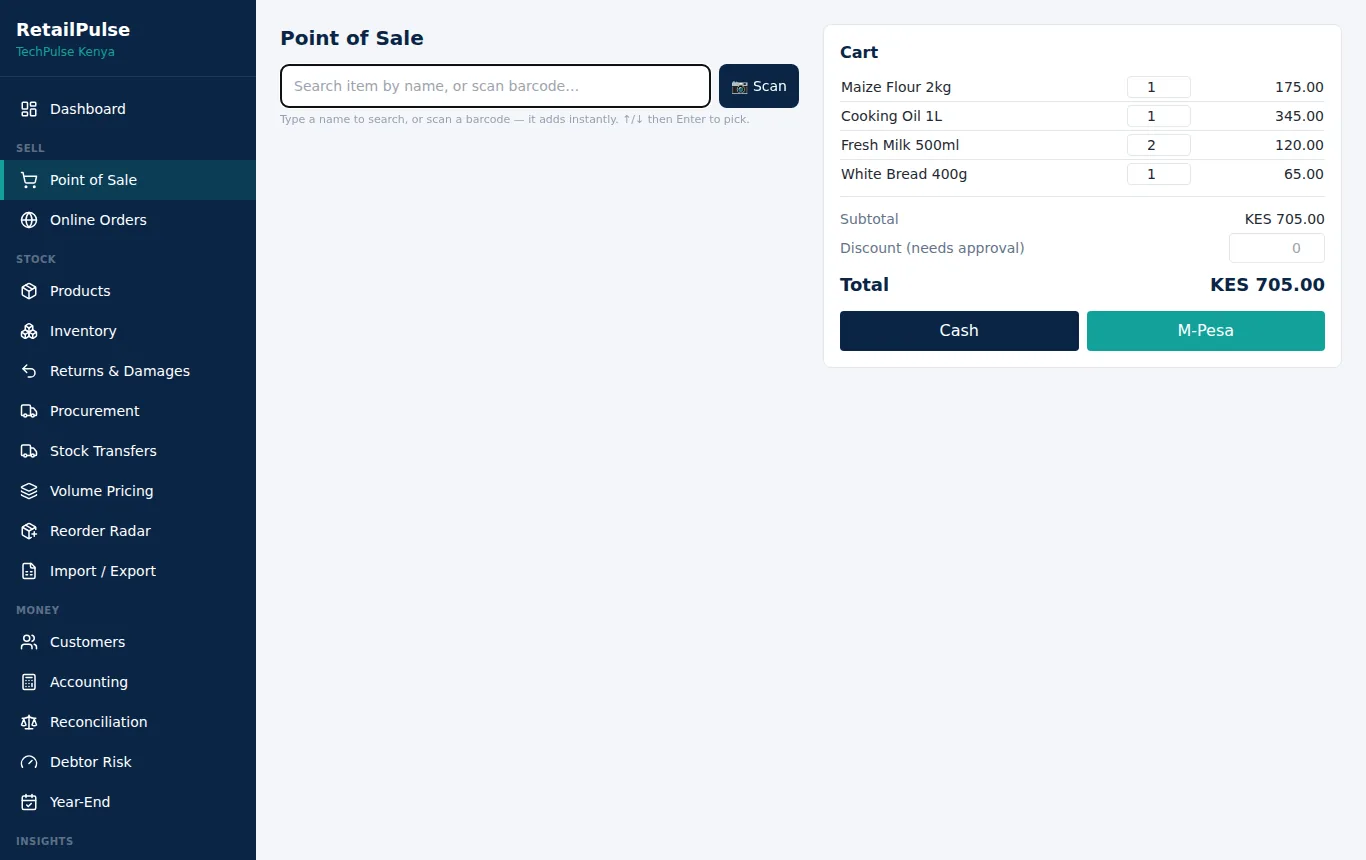
Every sale. When the cashier presses Pay, RetailPulse prices the cart, takes cash, card, account or an M-PESA STK push, reduces stock, posts balanced sales and cost-of-goods entries with VAT, and transmits the eTIMS invoice through OSCU or VSCU. If the internet is down, the invoice queues and retries automatically.
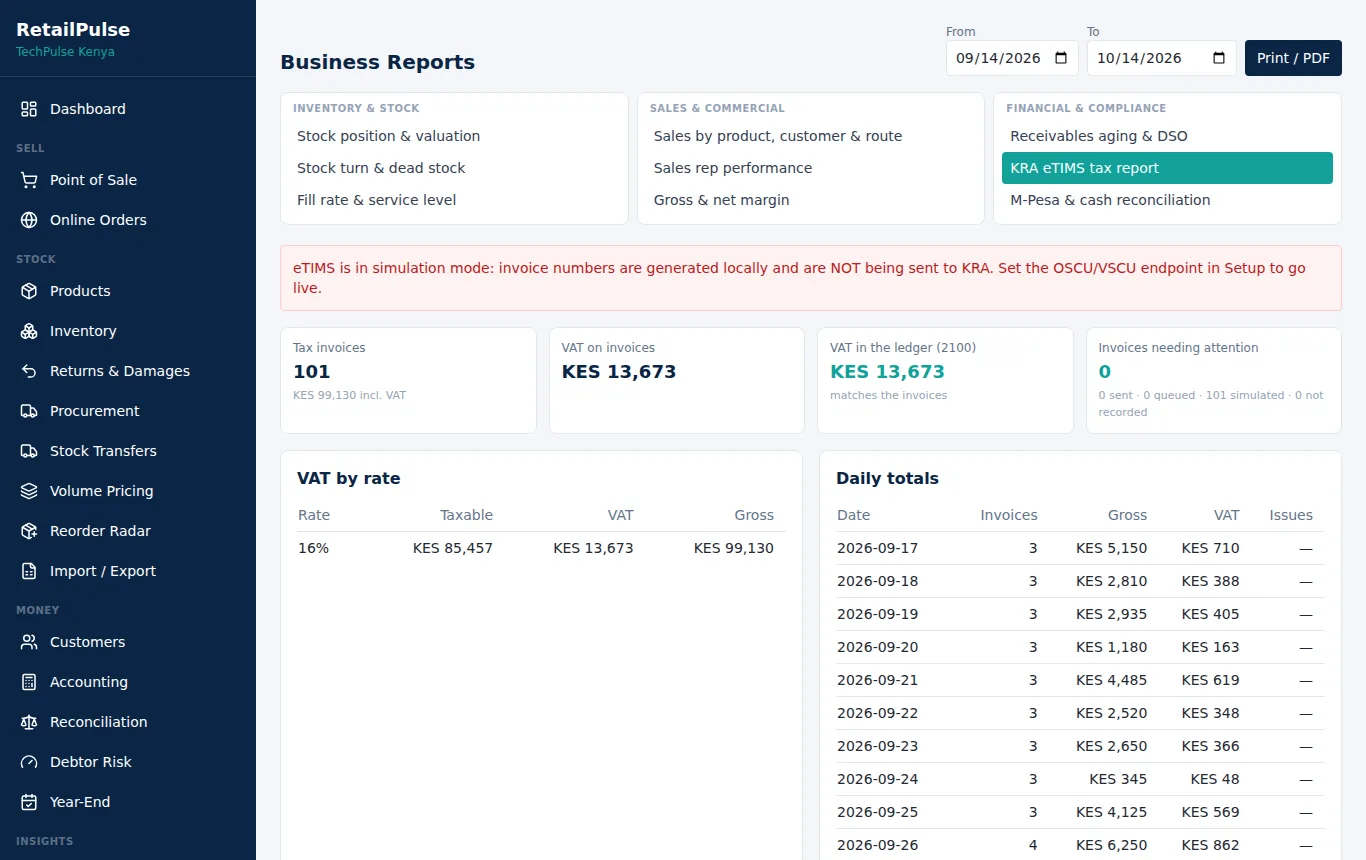
Knowing what reached KRA. The KRA eTIMS tax report lists tax invoices for the period, VAT by rate, and the VAT on your invoices checked against the VAT payable account in your books. It shows how many invoices were sent, how many are queued and how many KRA has not yet confirmed, and refunds raise credit notes. Until your eTIMS connection is live, a red banner says so, so nobody assumes they are compliant.
Stock records KRA is asking for. In RetailPulse, stock on hand is the total of recorded movements: goods received, sold, transferred between branches, returned, adjusted and written off, the same list in KRA’s notice. Movements are never edited; a correction is a new movement with a reason, and stock-takes post the difference.
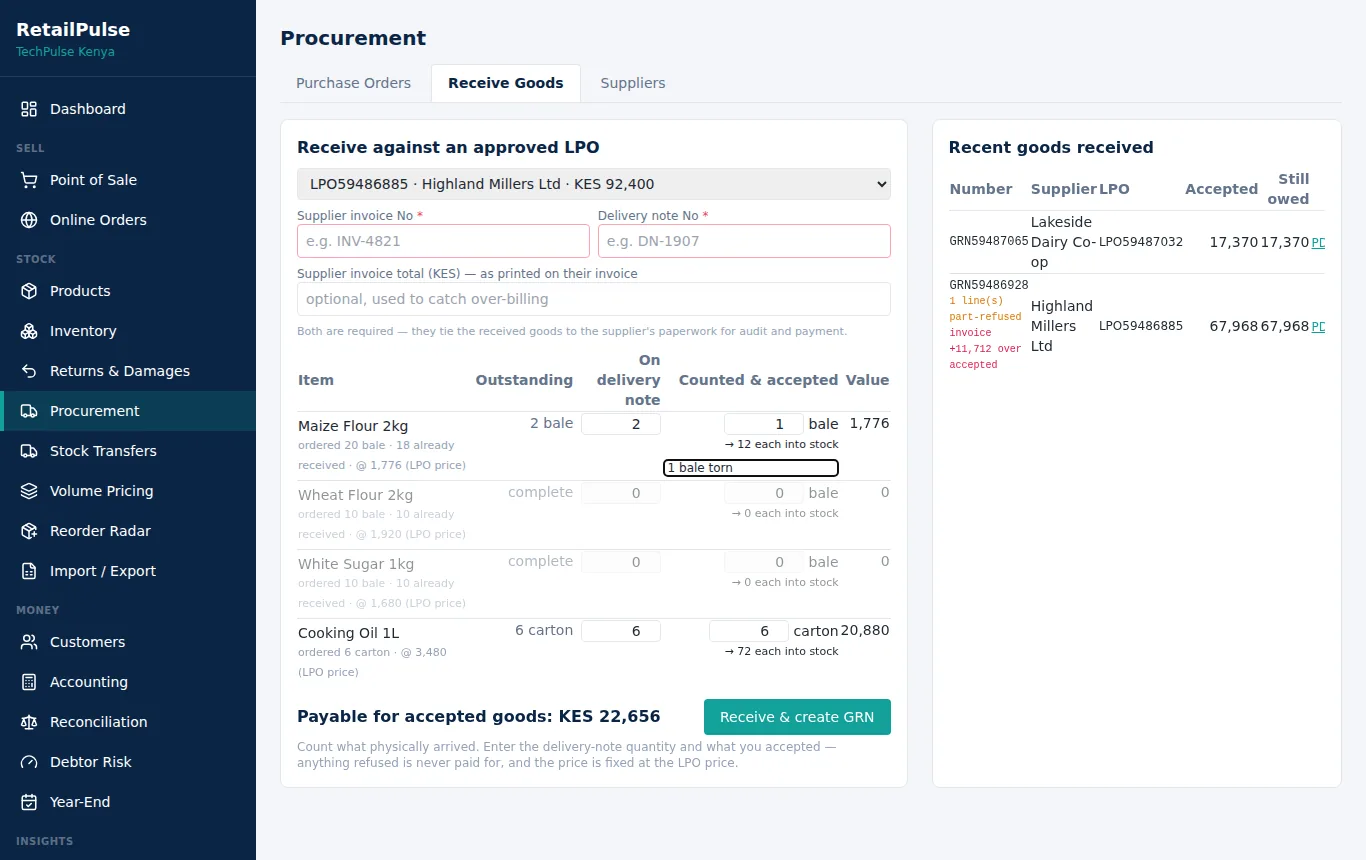
Purchases tied to supplier invoices. Goods are received only against an approved LPO, and the goods received note requires the supplier’s invoice number and delivery note number. Only the accepted goods, at the LPO price, become payable, and over-billing is flagged. That gives you a clean trail from each supplier invoice to the stock on your shelf.
Records you can produce. An append-only audit trail logs every sale and change, and the whole database is backed up every night on your own server.
Setup starts from KES 15,000 with the first year’s licence free, then from KES 10,000 a year, with no per-cashier fees. See full pricing or all 30 RetailPulse screens.
eTIMS 2026: questions shop owners ask
Is there a new eTIMS deadline in 2026?
There is no single switch-on date ahead. From the 2026 year of income, which began on 1 January 2026, all income and expenses in your return must be backed by eTIMS or TIMS invoices. The 2025 relief for expenses without eTIMS invoices was for that year only.
What is the eTIMS penalty in 2026?
Under the Finance Act 2026, failing to comply with electronic tax systems, including issuing electronic tax invoices, attracts the higher of 5% of the tax due, KES 100,000 for a company or KES 10,000 for an individual. The Commissioner must consider whether the failure was beyond your control and whether you took reasonable steps to comply.
Do I need eTIMS if I am not registered for VAT?
Yes. The Electronic Tax Invoice Regulations, 2024 require everyone carrying on business to issue electronic tax invoices, whether or not they are registered for VAT.
Can I still claim expenses without an eTIMS invoice?
Only exempt items, such as salaries under PAYE, imports, interest, airline tickets and payments subject to final withholding tax. Other costs without a valid eTIMS invoice can be disallowed.
Does KRA now track my stock through eTIMS?
KRA's notice of 7 September 2026 asks eTIMS users to keep accurate, up-to-date stock records. The notice sets no deadline and no penalty, and KRA is holding consultative forums with businesses first.
Does RetailPulse issue eTIMS invoices and keep stock records?
Yes. RetailPulse sends an eTIMS invoice with every sale through OSCU or VSCU, queues invoices when the internet is down, and keeps a full record of stock received, sold, transferred, returned, adjusted and written off.
Sources
- KRA, Implementation of the Stock Management Functionality for Electronic Invoicing, 7 September 2026
- Kenyans.co.ke, KRA notice on eTIMS rules ahead of the June 30 deadline, 8 June 2026
- Khusoko, KRA grants relief on eTIMS expenses, 8 June 2026
- PwC Kenya, Tax Alert: Highlights of the Finance Act, 2026, July 2026
- EY, Kenya enacts Finance Act, 2026, July 2026
- EY, KRA to validate income and expenses in income tax returns, December 2025
- KPMG Kenya, eTIMS, 2026
- Tech-ish, KRA orders businesses to keep stock records in TIMS and eTIMS, 4 September 2026
- Techweez, eTIMS is going beyond invoices, 8 October 2026
- HapaKenya, Understanding eTIMS, 23 January 2026
See eTIMS, stock and M-PESA working in one system
Book a free demo and we will show you RetailPulse issuing an eTIMS invoice inside a normal sale, receiving stock against a supplier invoice and closing the day.
Request a free demo →