

eTIMS is KRA’s Electronic Tax Invoice Management System: the way every business in Kenya issues tax invoices that KRA can see. If you sell anything, VAT-registered or not, it applies to you.
This is the plain version: what eTIMS is, who needs it, how it works at the till, and what changed in 2026. It is a guide, not tax advice, so confirm your own case with KRA or your tax adviser.
What is eTIMS, in one paragraph?
When you make a sale, your system sends the invoice to KRA. KRA’s control unit signs it and gives it a unique control unit invoice number and a QR code. The buyer can scan the QR code to confirm the invoice is genuine; according to KRA’s FAQ, it only gives a result once the invoice has reached KRA. KRA now has a record of the sale, and your buyer has proof of the cost.
Who needs eTIMS?
Everyone carrying on business. The Electronic Tax Invoice Regulations, 2024 apply whether or not you are registered for VAT. That includes shops, wholesalers, bars, salons, landlords, consultants and transporters. What differs is the tool each one should use.
| Your business | Usual eTIMS option |
|---|---|
| Small business, not VAT registered | eTIMS Lite: web on eCitizen, or USSD *222# |
| Services only, 10 invoices a month or fewer | eTIMS Online portal |
| Selling goods, no invoicing system yet | eTIMS Client (Windows) |
| Shop, chemist or hardware with a POS | OSCU, integrated with the POS |
| Supermarket, wholesaler or busy multi-till business | VSCU, integrated with the POS or ERP |
From KRA’s eTIMS taxpayer guidelines. Our OSCU vs VSCU guide explains each option in detail.
Why eTIMS matters more in 2026
- Your costs depend on it. Since 1 January 2026, iTax checks the income and expenses in your return against eTIMS invoice data (KRA notice of 10 November 2025). A genuine cost without a valid eTIMS invoice can be disallowed and taxed as profit.
- Your customers depend on it. Business buyers need your eTIMS invoice, with their PIN on it, to claim the cost. A supplier who can’t issue one is a supplier they may drop.
- Stock is next. KRA has told businesses invoicing through TIMS or eTIMS to keep stock records aligned with what they invoice (KRA), with consultative forums before any deadline.
The penalties and dates are covered in eTIMS 2026: the deadline, the penalties and your POS.
How eTIMS works at the till
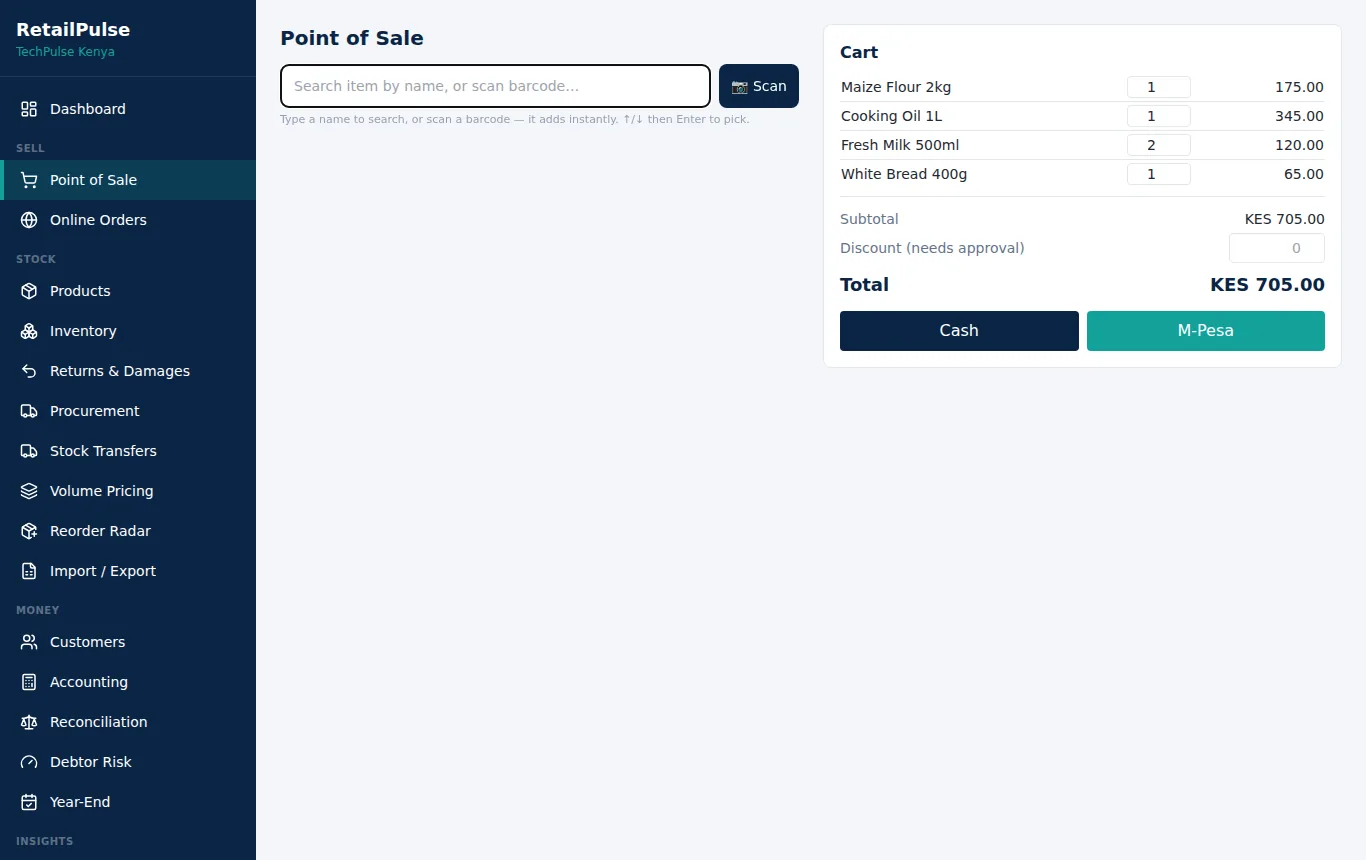
With an integrated POS, the cashier does nothing extra:
- The cashier rings up the sale and takes cash, card or M-PESA.
- The POS sends the invoice to KRA’s control unit and gets back the control unit invoice number.
- The receipt prints with the number and the QR code.
- Stock reduces and the sale posts to the books.
If the internet drops, a good POS keeps selling, queues the invoice and sends it when the connection returns. A refund raises a credit note that refers back to the original invoice; KRA notes that one credit note cannot reference several invoices.
Three mistakes to avoid
| Mistake | Better |
|---|---|
| Writing eTIMS invoices at the end of the day | Issue them at the counter, as part of the sale |
| Buying from suppliers who give no eTIMS invoice | Ask for one, with your PIN, before you pay |
| Assuming every invoice reached KRA | Check a report of sent, queued and unconfirmed invoices |
How RetailPulse handles eTIMS
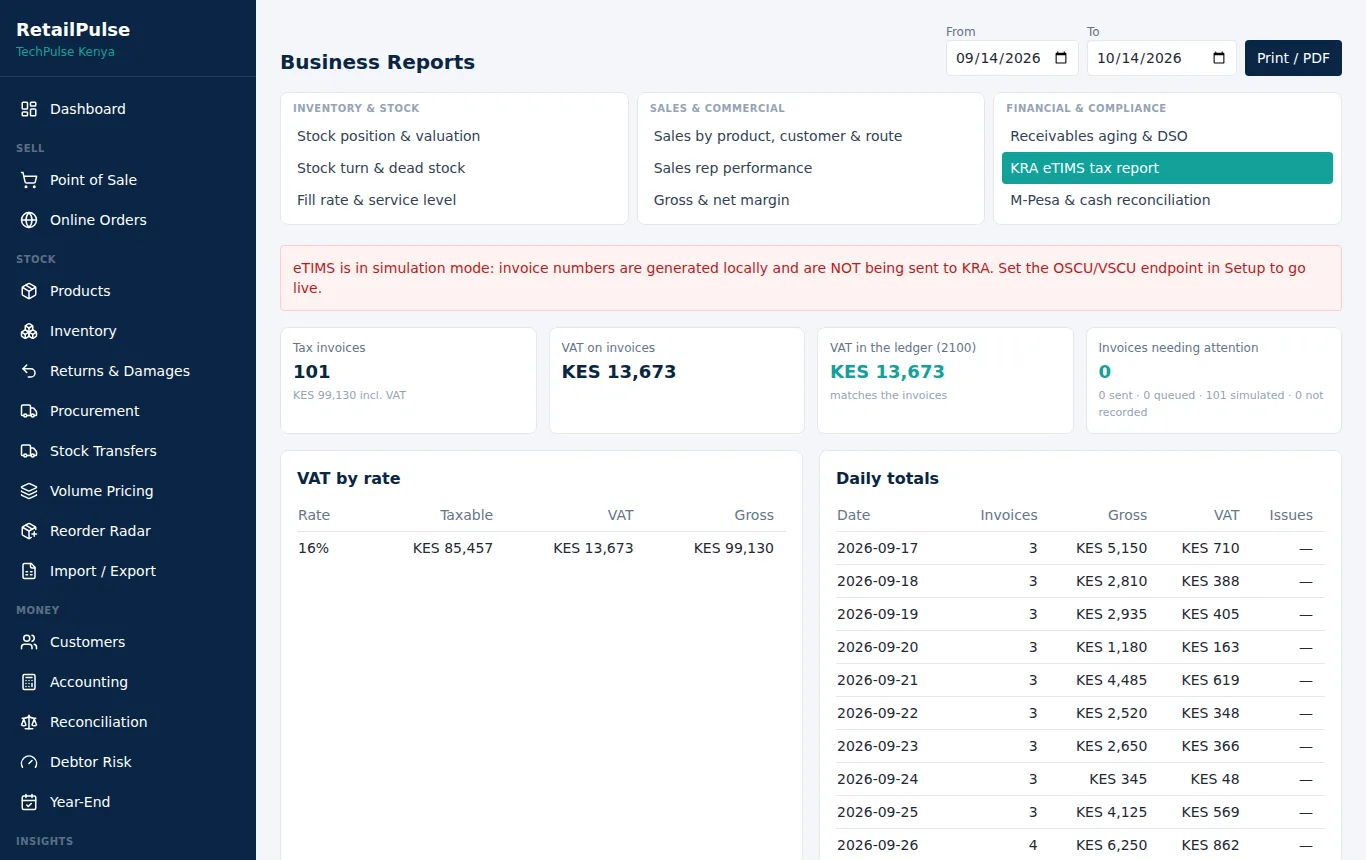
RetailPulse issues the eTIMS invoice as the cashier completes the sale, through OSCU or VSCU, with the control unit invoice number and QR code on the receipt. Invoices queue and retry when the internet is down. The KRA eTIMS tax report shows tax invoices for the period, VAT by rate, and which invoices were sent, are queued or are not yet confirmed. You can run in simulation while your KRA onboarding is approved.
Plans start at KES 2,500 a month, billed yearly, with setup from KES 25,000 and no per-user fees. See RetailPulse pricing.
See eTIMS working inside a normal sale
Book a free demo and we’ll ring up a sale, print the eTIMS receipt with its QR code and show you the tax report.
Questions people ask
What is eTIMS in Kenya?
eTIMS is KRA’s Electronic Tax Invoice Management System. Each sale is sent to KRA, signed by a control unit and given a unique control unit invoice number and a QR code that buyers can scan to confirm it.
Who must use eTIMS?
Everyone carrying on business in Kenya, whether or not they are registered for VAT, under the Electronic Tax Invoice Regulations, 2024. The right tool depends on the business, from eTIMS Lite on *222# to a POS integrated through OSCU or VSCU.
Is eTIMS free?
KRA’s own eTIMS options, such as eTIMS Lite, the Online portal and the eTIMS Client, are provided by KRA. Integrating your own POS or ERP through OSCU or VSCU is done by an approved integrator, a software vendor or your own developers.
Why does my eTIMS QR code not verify?
According to KRA, the QR code only gives a result once the invoice has been transmitted to KRA. If the invoice is still queued because the till was offline, it will verify after it is sent.
Sources
- KRA, eTIMS Taxpayer Guidelines, 2024
- KRA, FAQs: electronic tax invoice
- KRA, Stock management functionality for electronic invoicing, September 2026
- Streamline Feed, KRA now matches tax returns against eTIMS and customs data, 7 September 2026
- HapaKenya, Understanding eTIMS, 23 January 2026