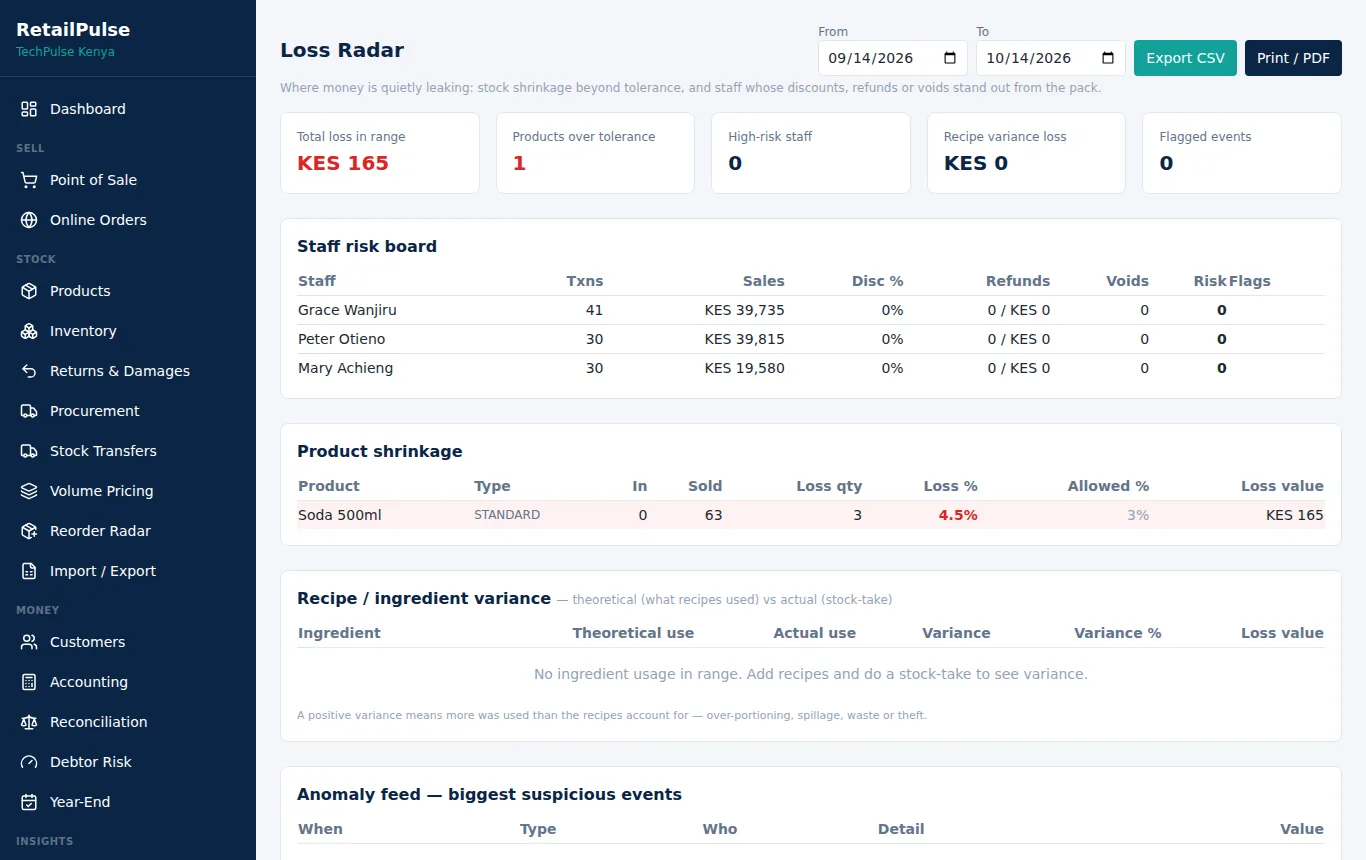
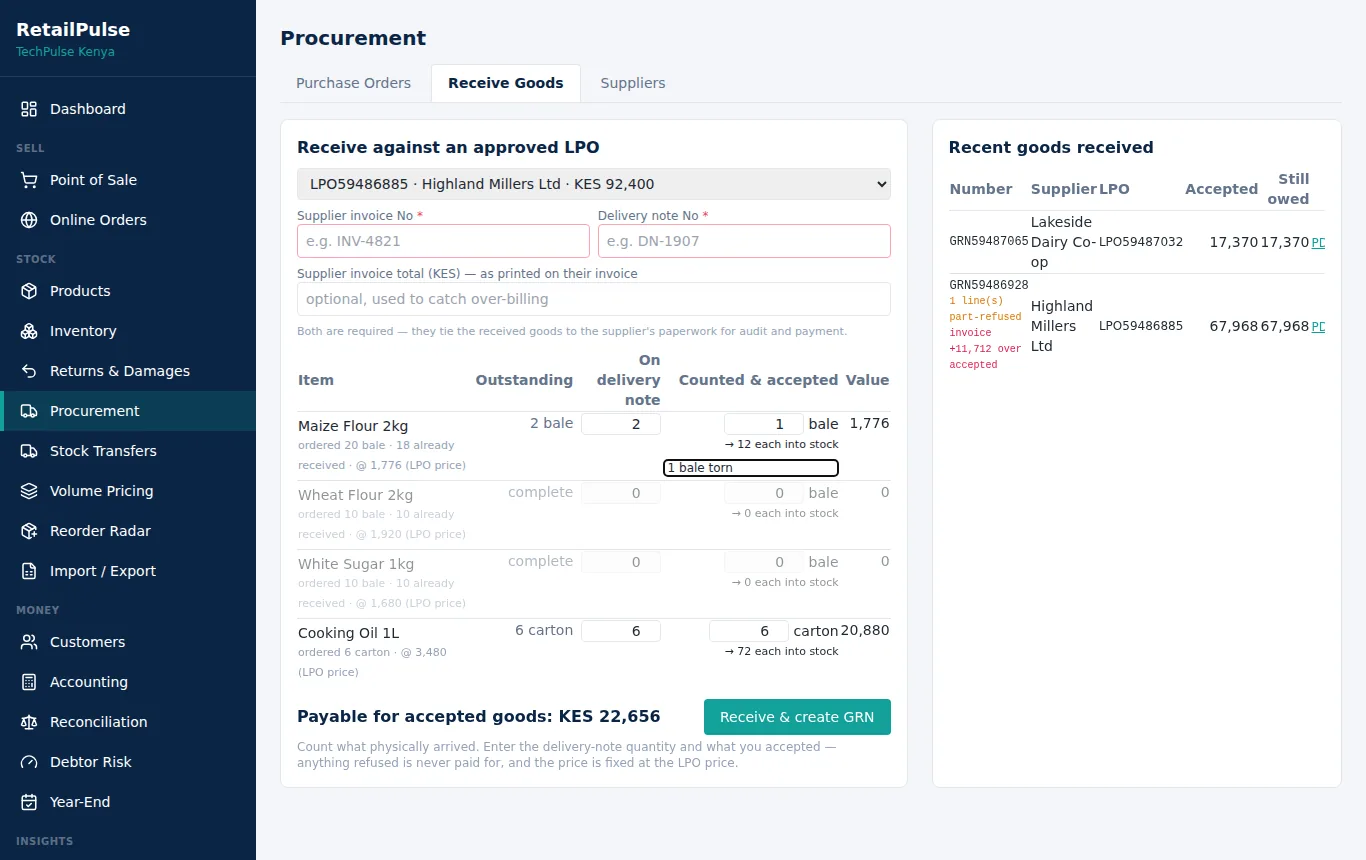
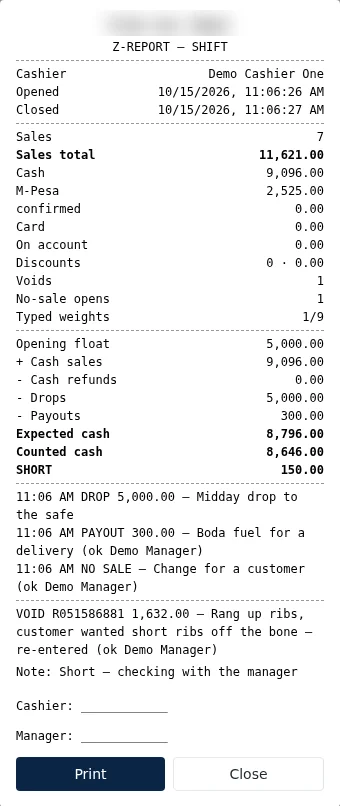
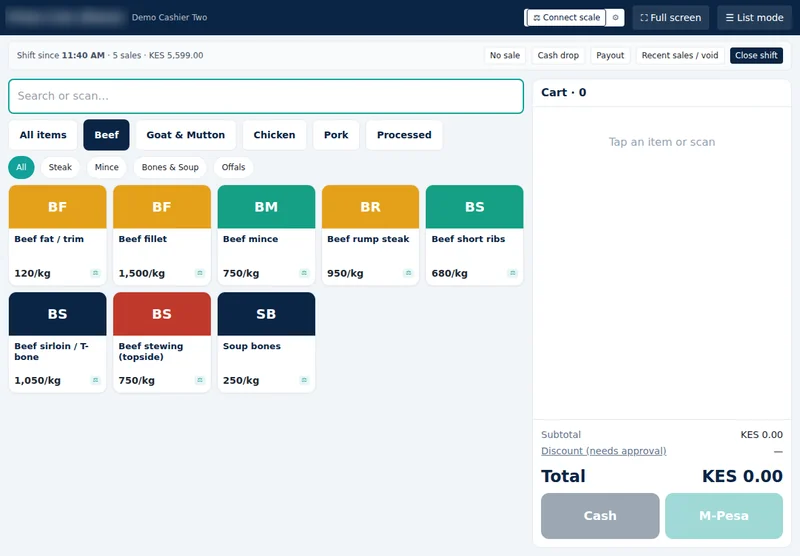
Variable-weight selling done right: put it on the scale, price by the kilo, print the label and take payment, while RetailPulse tracks yield and moisture shrinkage so the meat, and the money, stay accounted for.
Setup KES 15,000 · first year licence free · then KES 10,000/year · no per-cashier fees · See full pricing

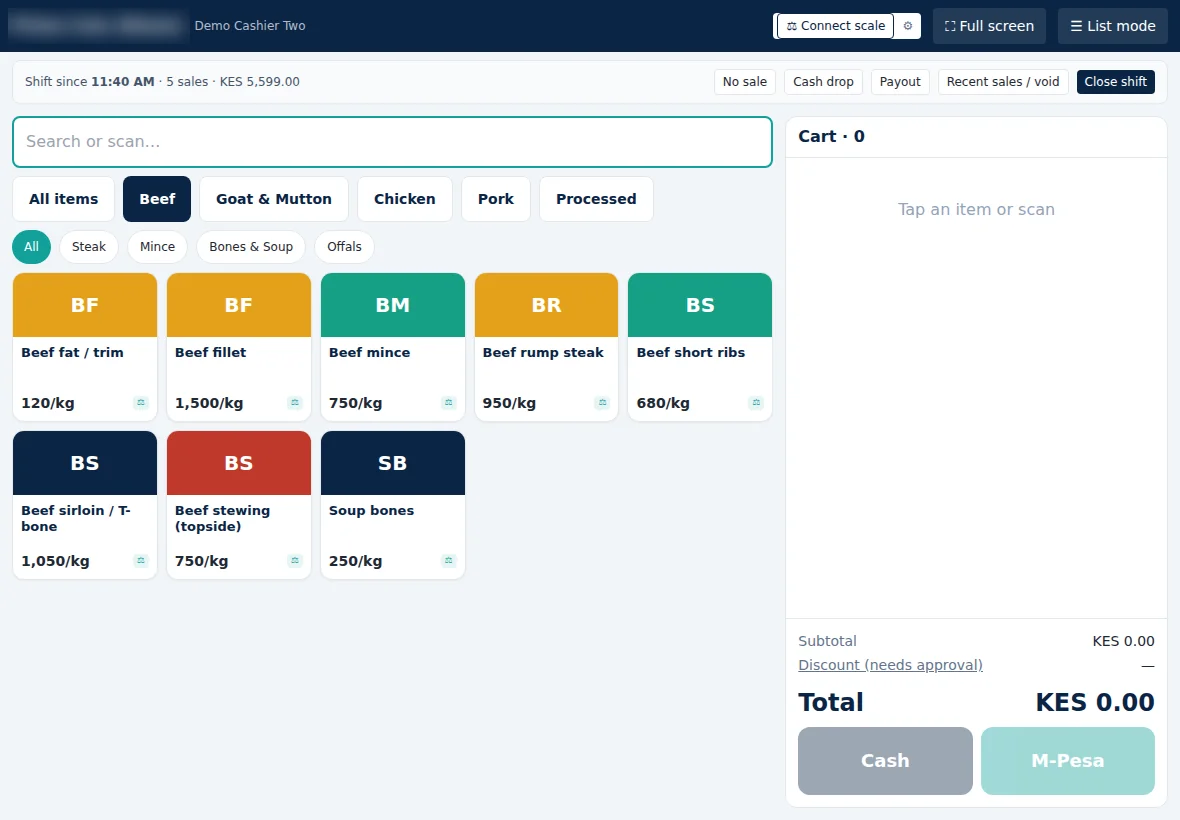
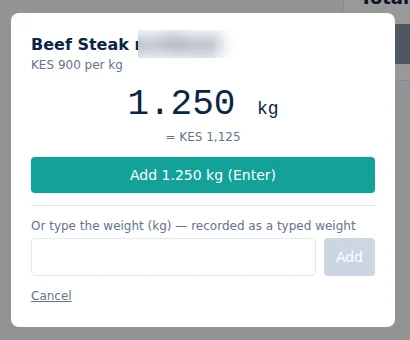
The weight comes straight from the scale or a scanned pack label, priced per kg with an instant total. No mental maths, no undercharging.
Set an allowed moisture-shrinkage % per product; losses beyond it are flagged automatically.
Receive a carcass, sell it as cuts, and see the yield you actually got versus what you should have.
AI Loss Radar flags yield variance by product and by attendant, investigate the shelf, not the whole shop.
Record damaged or expired stock and send it to a loss correctly, so your profit is honest.
Live stock in the cold room, freezer and display, with reorder alerts before you run dry.
Price per kilo, tare weight, instant total, sell any variable-weight item in seconds.
Printed weight labels and receipts with your logo and the eTIMS QR; email a PDF if you prefer paperless.
A permitted loss % per product; the system flags exactly which item and which day ran over.
Carcass in, cuts out, compare actual yield to expected and price your cuts to protect margin.
Live stock, damaged-goods logging, and spoilage recorded as a proper loss in the books.
M-PESA STK & Till, cash and card, weigh, print, paid.
Tuned to yield variance so under-weighing and quiet theft surface before they add up.
Profit per product and per attendant, so you know what actually earns and who performs.
The number that saves you money: set an allowed shrinkage % per product. When losses run past it, RetailPulse tells you the exact item and day, so a slow leak at the scale becomes a question you can actually ask, not a mystery at month-end.
From the scale at the counter to the carcass on the cutting table and the cash-up at the end of the shift. These are RetailPulse Butchery screens with a demo butchery’s data.


Fictional demo data. See all RetailPulse screens
RetailPulse works with standard butchery scales. The weight goes into the sale without anyone typing it, so the customer pays for exactly what is on the scale.

A POS scale with an RS-232 or USB output connects to the till. The live weight appears on screen and is only accepted once the reading is steady.
The scale prints a pack label with an EAN-13 barcode carrying the cut and weight. The cashier scans the label and the line comes in automatically.
Each weighed line records whether its weight came from the scale, a label or was typed. Typed weights can be watched per cashier or switched off altogether.
Weight-and-price pack labels and shelf barcodes print from RetailPulse on any label printer. Thermal receipts carry your logo, KRA PIN, M-PESA till number and the eTIMS QR code.
Use a scale verified and stamped by Weights & Measures. We configure it with RetailPulse on site, along with the receipt printer, cash drawer and scanner.
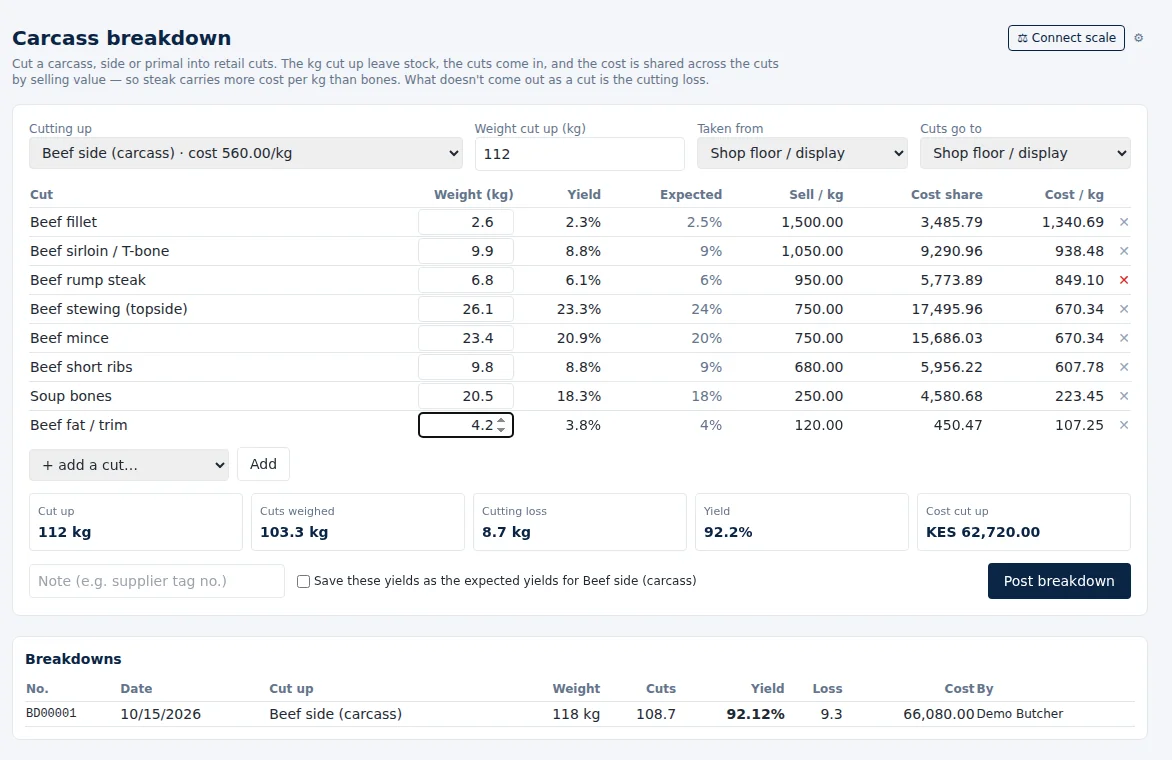
Most butcheries know what they paid for the carcass and what they sold the cuts for. Few know whether the fillet or the soup bones made the money. RetailPulse’s carcass breakdown answers that.

| Cut (demo) | Yield | Expected | Sells at /kg | Cost /kg |
|---|---|---|---|---|
| Beef fillet | 2.3% | 2.5% | 1,500 | 1,340.69 |
| Sirloin / T-bone | 8.8% | 9% | 1,050 | 938.48 |
| Beef mince | 20.9% | 20% | 750 | 670.34 |
| Soup bones | 18.3% | 18% | 250 | 223.45 |
| Whole side | 92.2% | bought at 560 | KES 62,720 |
Save a good breakdown as your expected yields, and every future carcass is compared against it. A yield that keeps falling short is the first sign of poor cutting, the wrong supplier or meat walking out of the back.
Meat moves from the delivery bay to the cold room, the freezer and the display. RetailPulse follows it.
Separate stock locations. Deliveries go straight into the cold room; meat is moved to the display as needed, so you know what is where.
On-hand quantities in kg and stock value update when meat is received, cut, moved, sold or written off.
Each weighed product has an allowed moisture-loss percentage. Loss Radar flags only losses beyond it.
Spoilage, trim, damage and expiry are written off with a reason and the name of who recorded it.
Packaged products such as sausages and bacon carry batches and expiry dates and are sold earliest-expiry first.
Count the cold room and display against the system; variances are posted and explained.
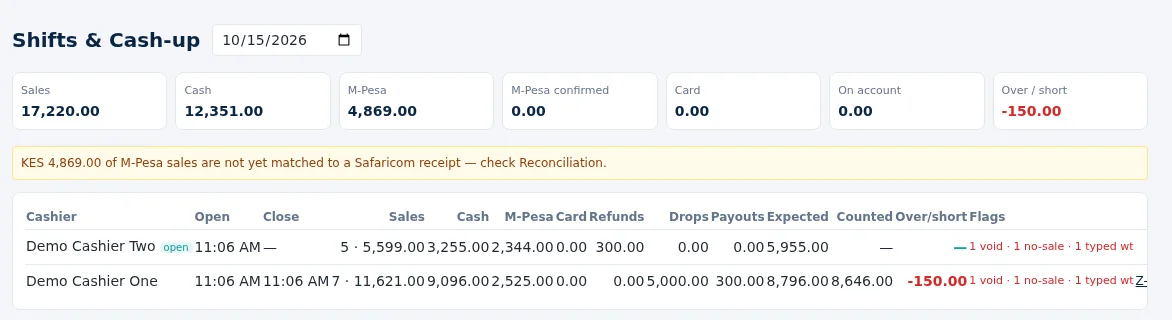
A butchery counter handles cash, M-PESA and credit all day, often with more than one cashier. RetailPulse closes the gaps:


All reports have date filters and print or export. If you open a second shop, Head Office shows every branch side by side.
Daily, weekly and monthly sales by branch, shift, cashier, cut, category and payment method.
Gross profit by cut and category from the true cost of each cut, plus stock position, stock turn and slow movers.
Yield per carcass against expected, cutting loss, and every write-off with its reason.
Cash, M-PESA and bank balances, transfers with charges recorded, and M-PESA reconciliation against Safaricom confirmations.
Supplier balances and payments, and credit accounts for hotels, restaurants and institutions with limits, statements and ageing.
Double-entry books posted by every sale, purchase, payment, return and write-off, with P&L, balance sheet, trial balance and year-end close.
A butchery runs on expensive equipment. RetailPulse keeps it on the books properly, so your profit and balance sheet tell the truth.
Band saw, mincer, cold room, freezers, scales, tills, furniture and vehicles, each with its cost and date.
Straight-line or reducing balance, charged to profit and loss every month so the cost is spread over the asset’s useful life.
Each asset shows at its current value. Equipment you already own is brought on to the books at its value on go-live day.
Sell or scrap an asset and RetailPulse records the sale price and the gain or loss.
Meat bought on an LPO goes to inventory and the supplier’s account when accepted; rent, electricity, transport and repairs go to expenses; equipment is capitalised.
Everything else a busy butchery needs, in the same system.
Staff records and payroll with PAYE, NSSF, SHIF and the Housing Levy, payslips and statutory reports.
Staff clock in and out, late arrivals are flagged, and you get an attendance register and hours per person.
Register casuals for offloading, cleaning and deliveries, record their days and approve payments.
Special price lists and volume breaks for hotels, restaurants and bulk buyers, on credit with limits and statements.
Customers browse your cuts with photos and prices, order and pay by M-PESA, with a WhatsApp link, for pick-up or delivery.
A touch-screen till at the counter, plus phones and tablets as extra tills or for stock counts. Owners check sales from their phone over a secure link.
RetailPulse works with standard hardware from any supplier. You buy the equipment you prefer, and we connect and configure it on site.
| Item | What to look for |
|---|---|
| Server and main till | A small business PC such as a Lenovo ThinkCentre M720q running Ubuntu Linux (no Windows licence needed), with a 15.6–21.5 inch touchscreen |
| Weighing scale | A labelling scale printing EAN-13 barcodes, or a POS scale with RS-232/USB output, 15–30 kg; verified and stamped by Weights & Measures |
| Receipt printer | 80 mm thermal, ESC/POS, with a network port and a cash-drawer port |
| Cash drawer | Printer-driven (RJ11/RJ12); opening it without a sale needs a manager’s PIN |
| Barcode scanner | USB 1D/2D, for packaged products and pack labels |
| Power and backup | A UPS for short power cuts, a generator for 24/7 trading, and a USB drive for the nightly backup copy |
Yes, in two ways. A POS scale with RS-232 or USB output can be cabled to the till so the live weight appears on screen and is only accepted when steady, or a labelling scale prints an EAN-13 pack label that the cashier scans. Typed weights are recorded as typed and can be switched off.
Yes. You record the carcass weight and the weight of each cut. RetailPulse shows yield per cut against your expected yield and the cutting loss, and shares the carcass cost across the cuts by selling value so each cut has a true cost per kg.
Each cashier works a shift with a float. Drops and payouts are recorded, the cash-up is blind, and voids, refunds, discounts and no-sale openings need a manager's PIN. A Z-report shows expected against counted cash for every shift.
Yes. Cold room, freezer and display are separate stock locations. Deliveries go into the cold room and meat is moved to the display as needed.
Yes. Equipment such as the band saw, mincer, cold room, freezers and scales goes on an asset register and is depreciated monthly, with net book value on the balance sheet and gains or losses on disposal.
Yes. It sends an M-PESA prompt to the customer's phone and matches Safaricom confirmations to sales, and receipts carry the KRA eTIMS invoice number and QR code once eTIMS is activated on your KRA PIN.
Bring your scale and your best-selling cut, and we'll show you the yield report. Choose a live demo, the full documents, or a call back.
We'll get back to you within one working day.