

Ask any head teacher what ate their evenings this year and you will probably hear one word: KEMIS. The Kenya Education Management Information System has taken over from NEMIS, and it now decides more than enrolment reports. It decides money.
This guide puts everything in one place: what KEMIS is, how it differs from NEMIS, what the Ministry has asked schools to do since January, and the mistakes that keep getting schools flagged. Every fact is dated and linked at the bottom, because KEMIS rules have changed more than once this year and you should be able to check them.
"Any projections that we do will be based on the data that is in KEMIS." Nelson Sifuna, Ministry of Education, July 2026
What KEMIS is, in plain terms
KEMIS is one national database for learners and institutions, from early years all the way to university. Primary, junior and senior schools, TVETs and universities all sit on it, and so do agencies such as KNEC, KICD and HELB. The idea was announced in August 2025, when Education PS Julius Bitok said the old system did not reflect real-time learner movement and that KEMIS would give every learner "a unique, traceable record".
The reason is not hard to see. When a learner transfers, drops out or gets counted twice, the numbers inflate and capitation goes to children who are not there. KEMIS is meant to end ghost learners and ghost schools, and move funding to accurate, needs-based data. It is funded through the World Bank-backed Kenya Primary Education Equity in Learning programme.
KEMIS vs NEMIS: what actually changed
| NEMIS (old) | KEMIS (now) | |
|---|---|---|
| Who is covered | Mostly basic education | Early years to university, TVET, plus KNEC, KICD, HELB |
| Registration | Existing NEMIS accounts | Every institution registers afresh through Institution Onboarding |
| Adding a learner | Record created, UPI issued | Assessment, KCPE or KCSE number and names are validated first; a mismatch stops you |
| Duplicates | "Learner already exists" errors, duplicates common | Validation workflow; creating a second record to bypass a mismatch is not allowed |
| Capitation | Based on NEMIS enrolment | Processed through KEMIS data |
| Who owns the data | Often delegated | Head of institution, with role-based logins |
How 2026 has gone so far
If KEMIS has felt rushed, that is because it has been. Here is the year in short:
- January: rollout starts. Over 8,000 secondary schools enrol in the first months.
- June: the Ministry makes KEMIS registration mandatory for public and private schools and ties capitation to it.
- 20 July: the Ministry reports 2.6 million learner records received against an expected 3.2 million. Public secondary schools are given until Friday 24 July to submit.
- 22 July: about 13,000 primary and junior schools are flagged for errors in their onboarding data. Deadlines follow: JSS on 20 July, primary on 25 July, learners on 30 July, validation on 31 July.
- Late August: the Education PS tells Parliament's Public Accounts Committee that the latest capitation used manually verified data, because KEMIS was not yet complete. A further 31 August deadline is set.
- September: Grade 10 selection runs through KEMIS for about 1.2 million learners. Schools report failed logins and choices that looked saved but were not.
- 1 October: the Director of Education issues a circular on a new learner validation workflow and a new Institution-Based Learner Summary Report. Grade 10 learners were to be onboarded by 30 September.
The lesson for heads is simple. Each new phase brings a new deadline, and each deadline checks the same thing: is your learner data correct?

What every school must do now
1. Get the institution record right, once
Most of the 13,000 flagged schools were caught on simple things. Use the exact name on your Certificate of Registration, not the name people call the school. Primary and junior school are registered as separate institutions, with the suffix in capitals and an underscore: _PS and _JS, not "-js". Use the school's official email and phone number, check the spam folder for the verification email, and submit only once. Duplicate submissions were one of the errors the Ministry named.
2. The head owns it. Keep logins personal
The Ministry has told heads not to hand KEMIS to a cyber café or a single overworked teacher. KEMIS has role-based access, so deputies, class teachers and clerks can get their own accounts. Do not share one password. This is also a data protection issue: you are entering children's birth details and parents' ID numbers. Our guide to the Data Protection Act for schools covers why this matters.
3. Gather documents before you sit at the screen
For each learner you will need:
- A birth certificate. Enter the entry number, not the serial number printed on the paper. For primary learners without one, a birth notification number or an affidavit can stand in for now.
- The parent or guardian's national ID number and phone number.
- A unique admission number. No two learners can share one.
- The assessment number. For Grade 10, that is the KJSEA index number.
- Class and stream, disability status, previous school, and county, sub-county and ward.
Grade 1 to 3 learners who do not yet have assessment numbers: the Ministry asked schools to wait for its guidance rather than invent numbers.
4. Type names exactly as the certificate has them
The October circular is clear that a name typed differently is the most likely cause of a mismatch. Enter names in the order First, Middle, Last, exactly as they appear in KNEC records or on the certificate. "Wanjiku Mary" and "Mary Wanjiku" are two different people to a computer.
5. Validate, never duplicate
Under the new workflow you first enter the learner's Assessment, KCPE or KCSE number and their names. KEMIS checks them against the existing record before it lets you type anything else. If they match, you continue with admission. If they do not, you get a "Name Mismatch" and cannot go on. The rule here is firm: do not create a fresh learner record to get around a mismatch. Take it to the KEMIS Helpdesk instead.
6. Reconcile, then reconcile again
Field officers now track every school using the Institution-Based Learner Summary Report: expected learners, onboarded, validated, outstanding, and the reason for each gap. Do the same check yourself before they call. Print a class list per stream from your own records and tick it against KEMIS. Any learner on your list who is missing in KEMIS is money your school is not being paid for.
7. Correct through the right channel, and keep proof
Mistakes in an approved record are fixed through the KEMIS editing workflow, which needs approval from the County Director. For anything with a deadline, such as Grade 10 choices, print the submitted record, check it and have it signed. When submissions appear to save but do not, a signed printout is your evidence.
8. Do not leave special needs learners behind
KEMIS now has a stage-based pathway for learners with special needs. Record disability status accurately at the start, avoid duplicate records when correcting, and escalate cases that stay stuck. Disability data also feeds the Ministry's assistive device programme.
The errors that keep getting flagged
| Error | How to avoid it |
|---|---|
| Informal or shortened school name | Copy the name from the Certificate of Registration |
| "-JS" or lowercase suffix | Use _JS and _PS in capitals |
| Wrong sub-county | Check against the registration certificate |
| Submitting twice | Submit once, then wait for the verification email |
| Learner name or date of birth not matching the certificate | Type from the document, not from memory or an old register |
| Birth certificate serial number instead of entry number | Use the entry number |
| Assessment number with a missing digit | Read it back to a colleague before saving |
| Two learners with one admission number | Fix your own register before you start |
| Wrong class or missing previous school | Confirm with the class teacher and transfer letter |
Notice how many of these start before KEMIS, in the school's own records. If your admission register lives in three Excel files and a counter book, KEMIS turns into detective work.
Where your school system fits in
Let us be straight about this: KEMIS entries are made in KEMIS, by the school. No school software can do your onboarding or validation for you, and you should be careful of anyone who claims otherwise.
What a good school management system does is make the KEMIS job shorter and cleaner. In Elimu SMS, every learner has one record: admission number, full name, class and stream, gender, guardian name and phone, and UPI. Fees, report cards and attendance all read from that same record, so there is one spelling of each name in the whole school, not five.
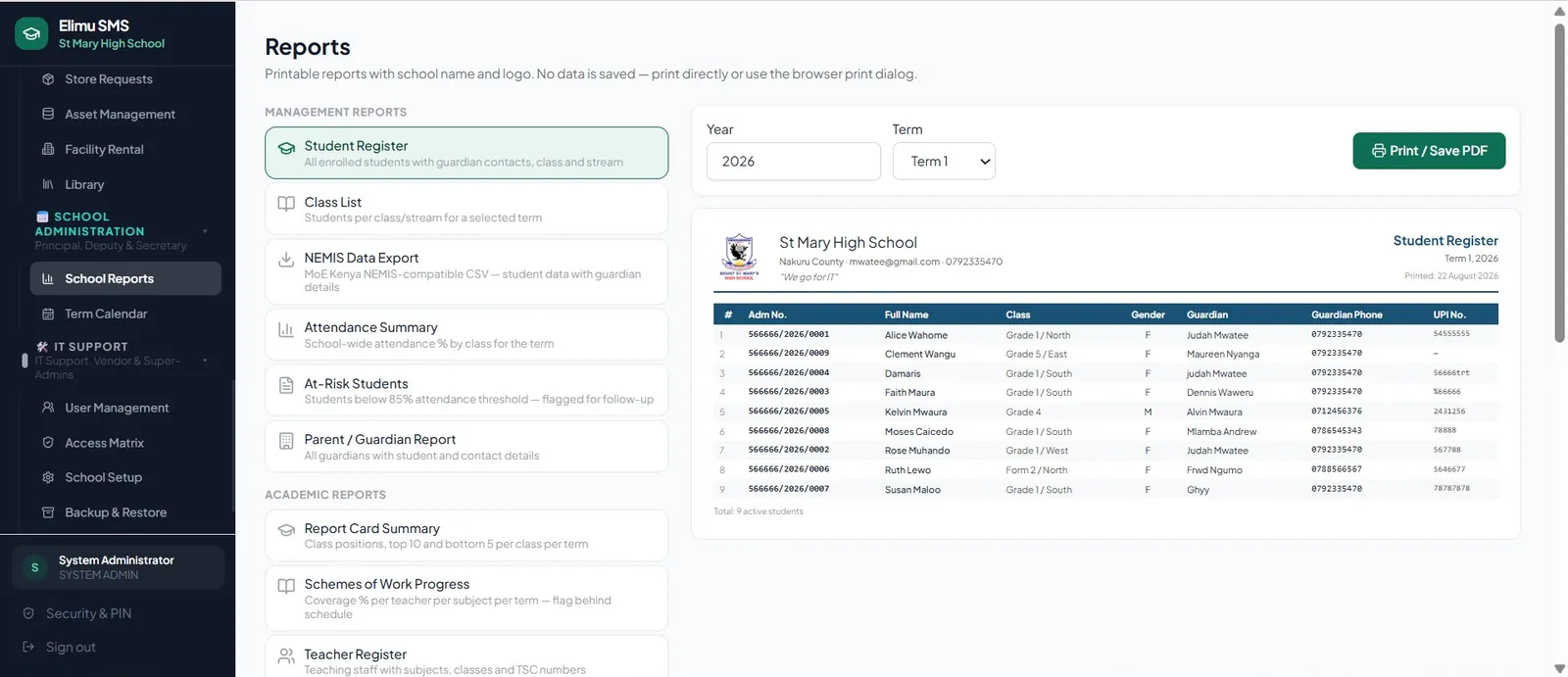
From the Reports module you can print a class list for each stream to tick against KEMIS, pull an at-risk list, and export learner data with guardian details as a NEMIS-compatible CSV. When the County office asks for numbers, they come from the same register your bursar uses for fees.
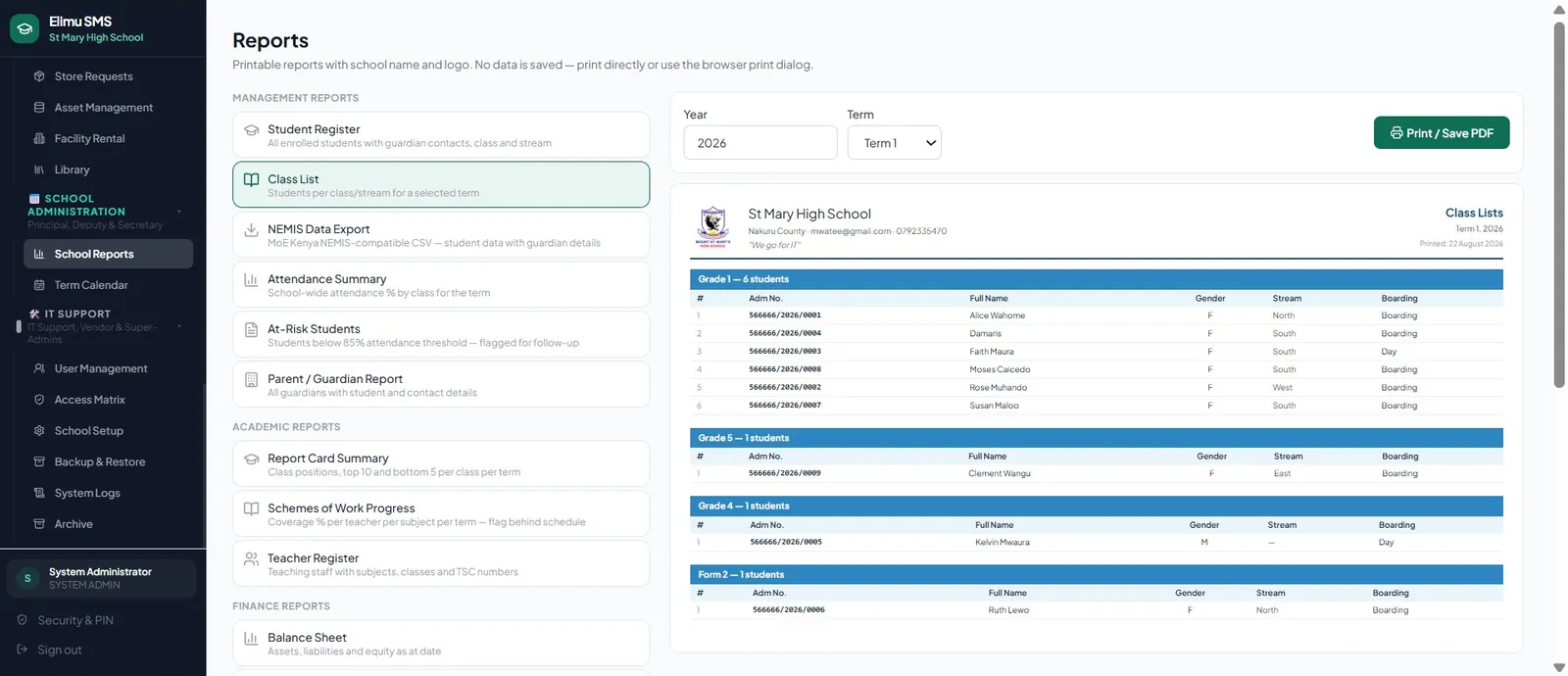
If capitation is now based on correct learner numbers, then correct learner numbers are a finance task as much as an admin one. That is why Elimu ties the register to fee collection and school accounting, so the learners you are paid for are the learners you actually bill and teach.
A short checklist to pin in the office
- Institution name copied from the registration certificate, _PS / _JS in capitals.
- Head of institution holds the main login. Everyone else has their own.
- Birth certificate entry numbers, guardian IDs and assessment numbers collected.
- Names typed First, Middle, Last, exactly as on the certificate.
- Mismatches go to the Helpdesk. No duplicate records.
- Class lists ticked against the KEMIS learner summary every term.
- Corrections through the County Director workflow, with printed proof.
Questions schools ask about KEMIS
Is KEMIS mandatory for private schools?
Yes. The Ministry of Education has made KEMIS registration mandatory for both public and private institutions. For public schools, capitation is now processed through KEMIS data.
What happens if our school is not on KEMIS?
Public schools risk missing capitation, because the Ministry says its funding projections are based on the data in KEMIS. Learners who are not onboarded and validated also face problems with placement and transfers.
KEMIS says "Name Mismatch". What do we do?
Check the spelling and order of the names against the KNEC record or certificate (First, Middle, Last) and try again. If it still fails, refer the case to the KEMIS Helpdesk. Do not create a new learner record to get around it.
Can a teacher or a cyber café do our KEMIS entries?
The Ministry says the head of institution owns the school's KEMIS data and should not delegate it to cyber cafés. Staff who need access should get their own role-based login, never a shared password.
Which birth certificate number goes into KEMIS?
Use the entry number on the birth certificate, not the serial or printing number. The learner's name and date of birth should match the certificate exactly.
Does Elimu SMS upload directly to KEMIS?
No. KEMIS onboarding and validation are done in the KEMIS portal by the school. Elimu SMS keeps a clean learner register you can work from, prints class lists per stream for cross-checking, and exports a NEMIS-compatible CSV with guardian details.
Sources
KEMIS guidance changes often. Check the official portal at kemis.go.ke and your Sub-County KEMIS coordinator before acting on any single article, including this one.
- The Standard, 7 Aug 2025: PS Bitok explains the shift from NEMIS to KEMIS.
- Education News: mandatory KEMIS registration and capitation.
- Education News: learner registration requirements.
- The Star, 21 Jul 2026: learner data deadline and capitation.
- Arena, 22 Jul 2026: 13,000 schools flagged for onboarding errors.
- Education News: the 31 August KEMIS deadline.
- Techweez, 9 Sep 2026: KEMIS and the Grade 10 selection.
- Education News Hub: portal, roles and birth certificate entry numbers.
- Arena, 2 Oct 2026: the 1 October circular on learner validation.
- Education News: Ministry learner validation guidelines.
See your learner register the way KEMIS needs it
Book a free demo and we will show you the Elimu SMS student register, class lists and reports, using demo data, in under 30 minutes.
Book a free demo →