

In a butchery, profit hides in the gap between the kilos you buy and the kilos you sell. Some of that gap is normal: bone, fat, trimmings and moisture. The rest is spoilage, under-weighing and quiet theft, and a normal till can’t tell you which is which.
This guide is for owners and managers of Kenyan butcheries, meat shops and nyama choma joints. It shows where the kilos go and how to turn “the meat shrinks” into numbers you can act on.
Where the kilos go
| Where weight disappears | Normal? | What to do |
|---|---|---|
| Bone, fat and trimmings when a carcass is cut | Yes | Know your expected yield per carcass and per cut |
| Moisture loss in the cold room and display | Yes, within limits | Set an allowed shrinkage % per product |
| Spoilage and expired stock | Partly avoidable | Record it as a loss, every time, with a reason |
| Pricing by eye or rounding down | No | Weigh every sale and price per kilo |
| Under-weighing, unrecorded sales, theft | No | Compare yield and cash per attendant and per day |
1. Weigh every sale
Pricing by eye leaks money on every customer, and it leaves no record to check later. When each sale is weighed and priced per kilo, with the tare taken off, every gram is charged for and every sale becomes a data point. A sale where the weight was typed rather than read from the scale should stand out, not blend in.
2. Track carcass-to-cuts yield
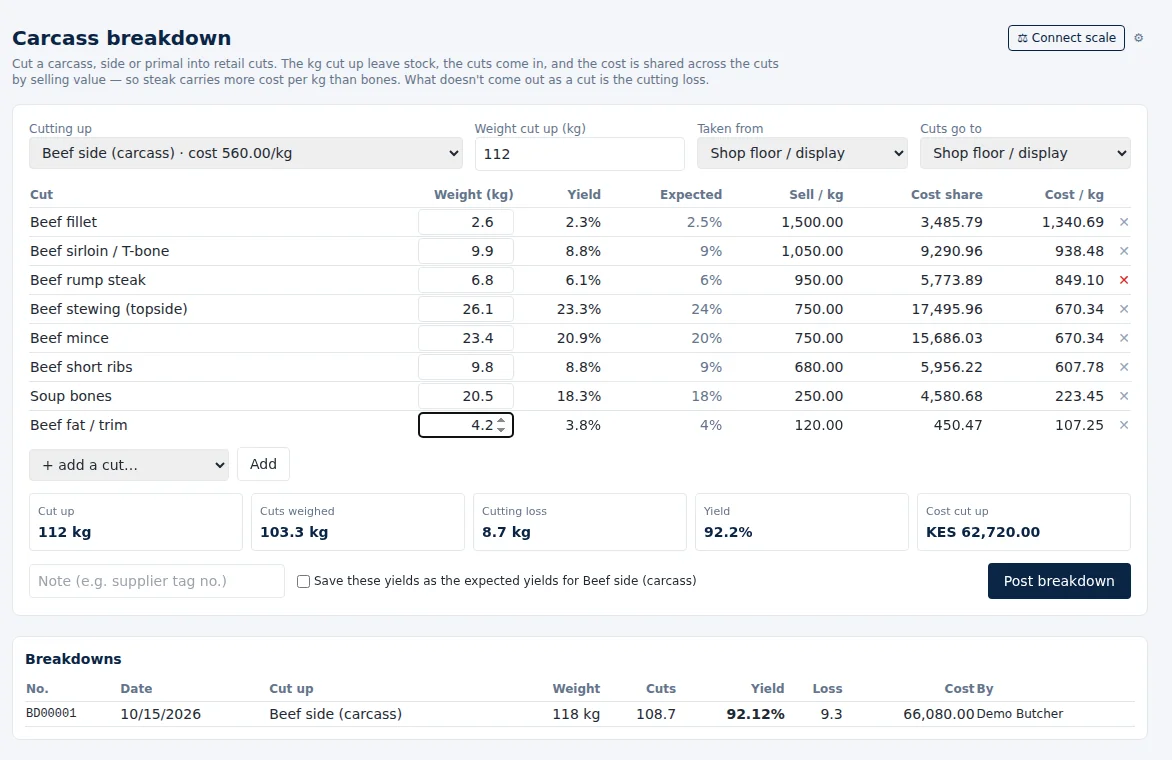
When a side of beef arrives, record its weight and cost. As it is cut into fillet, steak, mince, ribs and bones, record what each cut weighs. The difference between what came in and what went on the display is your cutting loss, and the true cost per kilo of each cut follows from it. Once you know your normal yield, a bad day stands out at once.
3. Set a shrinkage tolerance
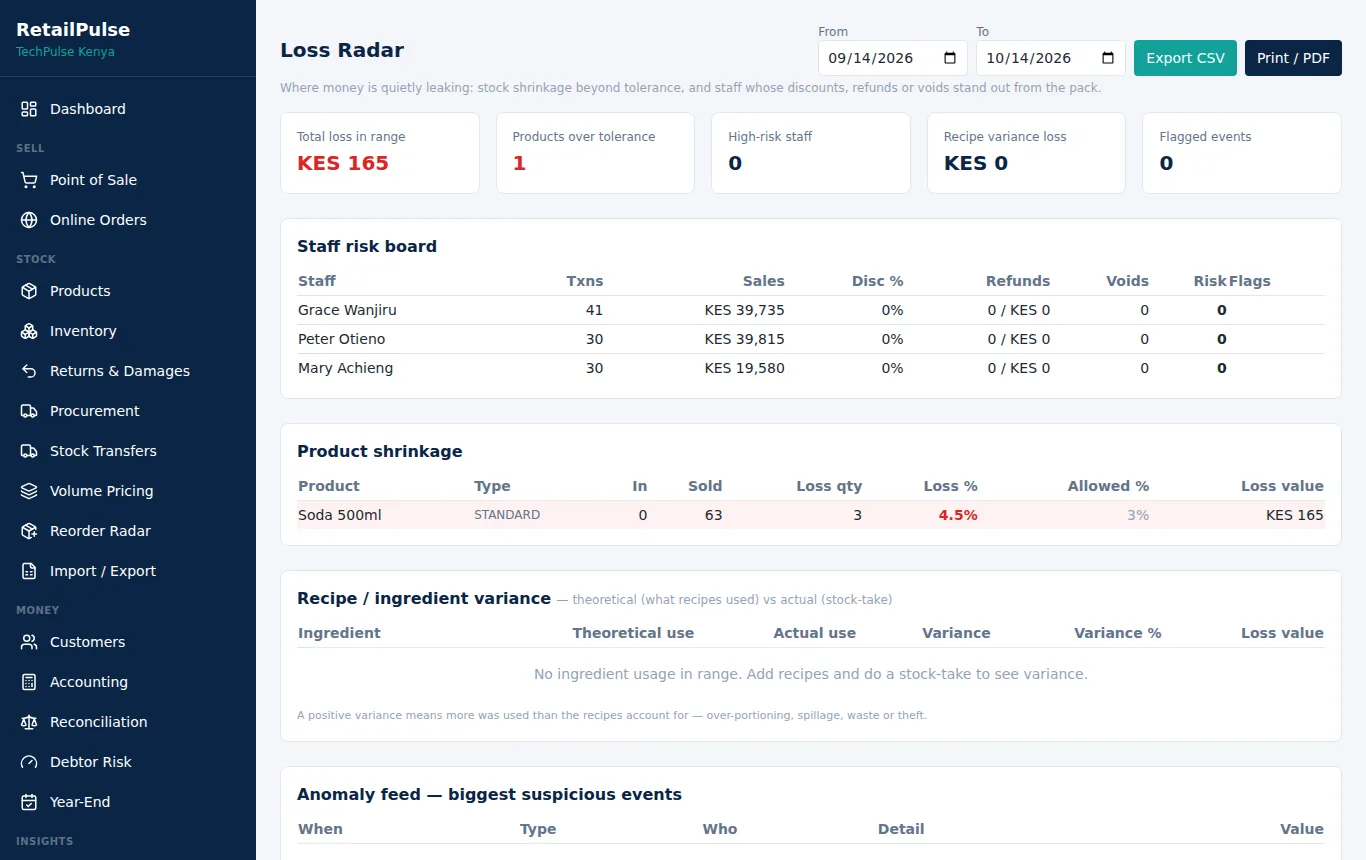
Meat loses moisture; that is not theft. Agree an allowed moisture-loss percentage for each product, based on your own records. Then only the losses that run past it need attention: a specific cut on a specific day, not “someone is stealing”. That keeps the conversation with staff fair and specific.
4. Record spoilage honestly
Wastage happens. Hiding it inside “sales were slow” makes your profit look worse than it is and hides the real cause. Record damaged or expired stock as a loss, with a reason, when it happens. A month of honest records tells you whether the problem is buying too much, the cold room, or the display.
5. Cash up per attendant, per shift
Close each shift with each attendant’s sales, cash, M-PESA and the expected versus counted cash. Watch voids, refunds, no-sale drawer openings and typed weights. Most of the time these are honest mistakes; patterns are what matter.
A weekly routine that takes 20 minutes
- Compare actual yield with expected yield for each carcass received.
- Look at products that ran over their shrinkage tolerance, and on which days.
- Check spoilage records against what you ordered.
- Review over/short and typed weights per attendant.
- Adjust prices per cut if the true cost per kilo has moved.
How RetailPulse Butchery helps
RetailPulse Butchery takes the live weight from the scale (or a scanned pack label) and prices per kilo, and records whether each weight came from the scale, a label or was typed. It breaks a carcass into cuts with yield against expected, cutting loss and the true cost per kilo; lets you set an allowed moisture loss per product; and Loss Radar flags cuts beyond tolerance and staff with unusual voids, refunds or discounts. Receipts carry the KRA eTIMS QR code, and payments can be taken by M-PESA STK, Till, cash or card.
For a butchery with scales the plan is KES 9,500 a month, billed yearly, with a one-time setup of KES 70,000 and no per-user fees.
See your real butchery margin
Book a free demo and we’ll show weigh-to-price, carcass yield and shrinkage tracking with cuts like yours.
Questions people ask
What is shrinkage in a butchery?
Shrinkage is the weight you buy but never sell: bone, fat and trimmings, moisture loss, spoilage, under-weighing and theft. Some of it is normal; the aim is to measure it so you can see the part that isn’t.
How much moisture loss is normal for meat?
It depends on the product, cut, cold room and how long stock is held. Rather than use a general figure, measure your own losses for a few weeks and set an allowed percentage per product from that.
How do I calculate carcass yield?
Weigh the carcass when it arrives, then weigh each cut as it is prepared. Yield is the total weight of saleable cuts divided by the carcass weight. Compare each carcass with your usual yield to spot problems.
How can I stop under-weighing at the counter?
Weigh every sale on a stamped scale connected to the till so the weight is not typed, watch typed weights and voids per attendant, and compare cash and yield per shift.
Sources
- Jaydee Innovation Hub, RetailPulse Butchery product documentation, 2026