

If you felt it at the pump this week, your suppliers felt it too. On Tuesday night EPRA raised fuel prices for the 15 October to 14 November cycle, and that cost will find its way onto your next delivery invoice.
This is not a guide to complaining about fuel. It is a guide to what a Kenyan shop, mini-supermarket or wholesaler can actually do this month so that higher transport costs come out of the price of goods, not out of your profit.
The new fuel prices in Kenya
These are EPRA’s maximum pump prices for Nairobi from midnight on 15 October 2026, as reported by The Star and Tech-ish. Stations can sell below them, but not above.
| Fuel (per litre) | Until 14 Oct | From 15 Oct | Change |
|---|---|---|---|
| Super petrol | KES 214.03 | KES 226.96 | +12.93 |
| Diesel | KES 217.86 | KES 227.76 | +9.90 |
| Kerosene | KES 191.38 | KES 219.87 | +28.49 |
Prices outside Nairobi follow transport distance. HapaKenya lists petrol at about KES 224 in Mombasa, the cheapest because it is next to the import terminal, rising to about KES 241 in Mandera.
Why it happened. Kenya imports all its fuel already refined, so pump prices follow the landed cost at Mombasa. According to Tech-ish, the landed cost of super petrol rose 11.81% while the shilling barely moved, from about KES 129.72 to KES 129.91 to the dollar. EPRA Director General Edward Kinyua said September was “the worst month for import costs” since the war in the Middle East began. Kerosene rose most because EPRA says a wide price gap between kerosene and diesel encourages people to mix the two.
Two more things to watch. Pump prices still include VAT at a temporary 8% instead of 16%, and a return to 16% would add roughly KES 17 a litre. And EPRA reviews prices every month, so the next change is due on 14 November.
How fuel prices reach your shelves
Diesel moves almost everything a Kenyan shop sells. It runs the lorries from the factory, the distributor’s vans, the matatu or boda you use to restock, and the farm machinery behind your fresh produce. HapaKenya expects transporters to pass their higher costs on to cargo owners, which means your suppliers.
That usually shows up in three ways over the next few weeks:
- Higher prices on supplier invoices, sometimes a few shillings an item, sometimes a new “transport charge” line.
- Higher costs for your own trips to the wholesaler or market, and higher rider charges for deliveries.
- Customers with less money, because their own fares and kerosene went up, so they compare prices more carefully.
The danger is not the price rise itself. It is selling at last month’s price for goods that cost you more this month, without noticing.
What to do this month
1. Reprice item by item, not all at once
The temptation is to add five shillings to everything. Don’t. Your costs will not rise evenly, and customers notice when the price of sugar or flour jumps for no reason. Change a price when that item’s cost changes, the day the new supplier invoice arrives.
2. Use margin, not markup
This is where many shops lose money without knowing. Here is a simple example with a 2kg packet of flour:
| Situation | Cost | Selling price | Margin |
|---|---|---|---|
| Last month | KES 180 | KES 200 | 10.0% |
| Supplier adds KES 6, price unchanged | KES 186 | KES 200 | 7.0% |
| Add 10% to the new cost (markup) | KES 186 | KES 205 | 9.3% |
| Keep a 10% margin | KES 186 | KES 207 | 10.1% |
The formula to keep your margin is: new price = new cost ÷ (1 − target margin). For a 10% margin, divide the cost by 0.9. If you sell 300 packets a month and leave the price at KES 200, the KES 6 increase quietly costs you KES 1,800 a month on that one product alone.
3. Protect the prices customers compare
Every shop has a handful of items people use to judge whether you are expensive: sugar, flour, cooking oil, bread, milk. Keep those as sharp as you can and recover the cost on items people do not compare as closely. That only works if you know your margin on each line.
4. Restock less often, but don’t overstock
Each trip to the wholesaler now costs more. Fewer, bigger orders cut transport cost per item. But stock you cannot sell is cash sitting on a shelf, and that is worse than a fare. Order fast movers in bigger lots and leave slow movers alone.
5. Charge delivery properly
If you deliver to customers, check what you charge against what riders now cost you. Many shops still charge last year’s delivery fee and absorb the difference without noticing.
6. Watch your own fuel and transport costs
Record every restocking fare, rider payment and fuel top-up as an expense, not from the till drawer without a note. At the end of the month you want to see exactly how much transport cost you, and whether your prices covered it.
How RetailPulse helps when costs move
RetailPulse is our POS system and business management software for Kenyan shops, supermarkets, wholesalers, bars and butcheries. It does not change your prices for you. It shows you, clearly, which ones need changing.
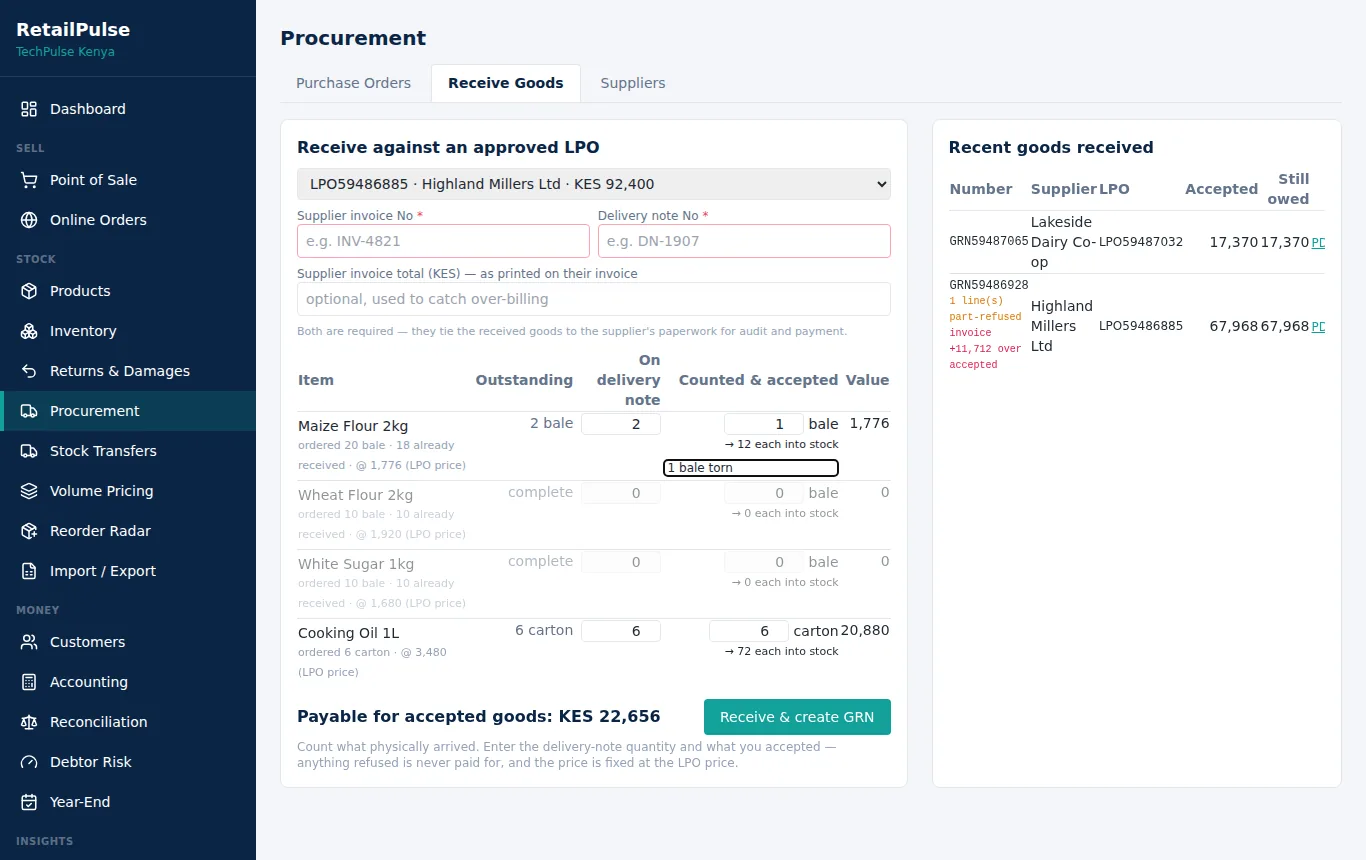
New costs are captured at the back door. When a delivery arrives, it is received against the purchase order, at the agreed price, with the supplier’s invoice number. Stock is valued at weighted-average cost, so when a supplier puts prices up, your cost per item updates with the delivery. If the supplier invoices more than the agreed price, it is flagged. See how this works on our inventory management page.
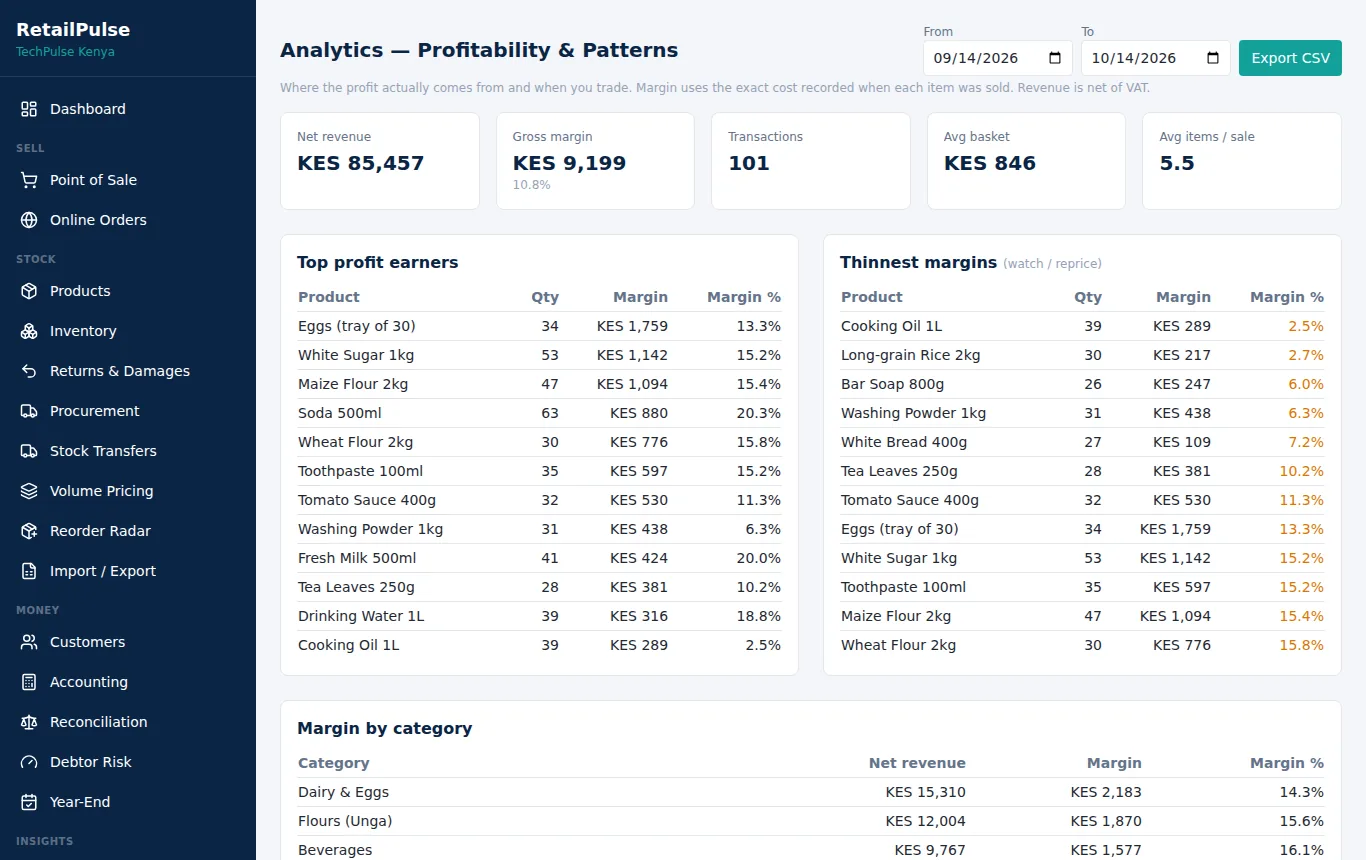
The thinnest margins, listed for you. Profitability analytics show gross margin for any period, your top profit earners and a list of the products with the thinnest margins, marked for repricing. Margin is worked out from the exact cost when each item was sold, so last month’s cheaper stock does not hide this month’s problem.
Order smarter. Reorder Radar takes your supplier lead time and safety days and works out what to order from how fast each item sells, and it lists slow and dead stock with the cash tied up in each line. That is how you make fewer trips without filling the store with things that will not move.
Transport costs in the books. Petty cash and expenses post to accounts such as transport and fuel, and business reports share operating expenses across categories to show net margin, not just gross. Online orders record what you collected for transport and what you owe riders. And eTIMS and M-PESA work in the same till.
Setup starts from KES 15,000 with the first year’s licence free, then from KES 10,000 a year, with no per-cashier fees. See full pricing or all 30 RetailPulse screens.
Fuel prices and your shop: questions owners ask
What are the new fuel prices in Nairobi?
From 15 October to 14 November 2026, EPRA's maximum pump prices in Nairobi are KES 226.96 for super petrol, KES 227.76 for diesel and KES 219.87 for kerosene per litre. Stations may charge less, but not more.
Why did fuel prices go up in October 2026?
EPRA linked the rise to higher import costs. The landed cost of super petrol rose 11.81%, and EPRA's Director General said September was the worst month for import costs since the war in the Middle East began. The shilling barely moved.
When is the next EPRA fuel price review?
EPRA reviews pump prices every month. The current prices run to 14 November 2026, when the next review is due.
Should my shop raise prices as soon as fuel goes up?
Not across the board. Raise prices when your own cost goes up, item by item, as new supplier invoices arrive. Raising everything at once risks losing customers on the items they compare most.
How do I work out a new selling price that keeps my margin?
Divide the new cost by one minus your target margin. For a 10% margin on an item that now costs KES 186, that is 186 divided by 0.9, which is about KES 207. Adding 10% to the cost gives only about a 9% margin.
Does RetailPulse change my prices automatically?
No. You decide your prices. RetailPulse records the cost of every delivery, shows the margin on every product and lists the thinnest margins, so you can see exactly which prices need attention.
Sources
- The Star, EPRA raises petrol by Sh12.93, kerosene by Sh28.49, 14 October 2026
- Tech-ish, Petrol rises to KES 226.96 in Nairobi and kerosene jumps KES 28.49, 14 October 2026
- HapaKenya, Pain at the pump as EPRA sharply increases fuel prices for October-November period, 14 October 2026
Prices are EPRA maximums for Nairobi as reported on 14 October 2026. Check EPRA’s official release for your town.
Know your margin before your supplier changes it again
Book a free demo and we will show you how RetailPulse captures a supplier’s new price at delivery and shows which of your prices need to move.
Request a free demo →