

“OSCU or VSCU?” is one of the most common eTIMS questions Kenyan business owners type into search. Most of the answers online are written for developers. This one is written for the person who owns the till.
It matters more this year than last. Since 1 January 2026, iTax checks the income and expenses in your return against eTIMS invoices (KRA notice of 10 November 2025). In September, KRA told every business to keep its stock records aligned with what it invoices through eTIMS. Government suppliers now need eTIMS invoices that match exactly what they submit through IFMIS. And on 2 November, KRA and ICPAK ran a webinar for accountants on stock management in eTIMS and automated VAT assessments. The right eTIMS option makes all of that easier. The wrong one makes it a daily chore.
Below: the six eTIMS options in plain words, OSCU vs VSCU, and the invoice details people keep asking about: the control unit invoice number, item codes, packaging units and the QR code. It is a plain guide, not tax advice; confirm your own case with KRA or your tax adviser.
The six eTIMS options at a glance
All of these come from KRA’s eTIMS taxpayer guidelines. They all produce a valid electronic tax invoice. The difference is who they are built for.
| Option | Built for | What you need |
|---|---|---|
| eTIMS Lite (web on eCitizen, or USSD *222#) | Small and micro businesses that are not VAT registered | A phone. No other eTIMS solution active. |
| eTIMS Online portal | Services only (no goods), 10 invoices a month or fewer: landlords, consultants, lawyers, transporters | A browser and your KRA login |
| eTIMS Client, Android app | Small service businesses | Android 8.0+. KRA notes it has no stock management. |
| eTIMS Client, Windows | Businesses selling goods or services that have no invoicing system | Windows 10, 2GB RAM, 20GB storage |
| OSCU (Online Sales Control Unit) | Businesses with their own POS or ERP that is reliably online | Your system integrated with KRA’s OSCU API |
| VSCU (Virtual Sales Control Unit) | Businesses with their own system doing bulk invoicing, or not always online | A Java application running on your own server, integrated with your system |
One line worth reading twice: the Android client has no stock management. If you sell goods, that matters now that KRA wants stock records lined up with your invoices.
OSCU vs VSCU in plain words
Both are for businesses that already run their own invoicing system: a POS, an ERP or accounting software. Instead of typing every sale twice, your system sends each invoice to a control unit, which signs it and gives it a number. The question is where that control unit lives.
OSCU: the control unit sits at KRA. KRA’s OSCU/VSCU sign-up guide describes it as implemented and hosted at KRA. Your system calls KRA over the internet for each invoice. Nothing extra to install, but you depend on a working connection.
VSCU: the control unit sits with you. The same guide describes VSCU as implemented and hosted on the client side, as a Java application (Java 16 or later) that your system talks to. KRA points it at organisations that issue large volumes of invoices in a short time, and its taxpayer guidelines add businesses whose systems do not always run online.
| If your business… | Look at |
|---|---|
| Issues a few service invoices a month | eTIMS Online portal (free, no integration) |
| Is a small non-VAT kiosk or sole trader | eTIMS Lite (USSD *222# or web) |
| Sells goods but has no system yet, low volume | eTIMS Client (Windows), or a POS with eTIMS built in |
| Runs a POS in a shop, chemist or hardware with steady internet | OSCU |
| Is a supermarket, wholesaler or multi-till business, or has patchy internet | VSCU |
| Supplies government | Any option that gives you exact, matching invoices; an integrated system avoids retyping errors |
Either way, integration is done by an approved third-party integrator listed by KRA, or by self-integration. Sign-up starts on the eTIMS sandbox portal: you raise a service request, choose OSCU or VSCU, upload the eTIMS Commitment Form and wait for an approval SMS. The system is tested in the sandbox first, then moved to production.
The control unit invoice number and the QR code
Every invoice the control unit signs gets a unique number. KRA’s eTIMS FAQ calls it the control unit invoice number. It sits on the receipt next to the QR code, together with your PIN and name, the date and time, each item with its quantity and price, and the tax rate and totals.
Two practical points from the same FAQ:
- The QR code only verifies after the invoice reaches KRA. If your till was offline and the invoice is still queued, a customer who scans it gets no result until your system sends it. A good POS shows you what is still waiting.
- Credit notes must quote the original invoice, and one credit note cannot reference several invoices. Returns need to be linked to the sale they reverse.
People also ask whether the invoice is issued at the sale or afterwards. The law asks you to record each sale and issue and transmit the invoice through the system, and VAT falls due at the earliest of the events in section 12 of the VAT Act, such as delivery, invoice or payment. In practice: issue it at the counter, as part of the sale. Writing invoices at the end of the day is how gaps appear.
Item classification, SKUs and packaging units
Every item you send to eTIMS carries a few codes that confuse new users:
- Item classification code. eTIMS uses a subset of the global UNSPSC product codes, and an item cannot be created without one (Digitax integrator docs). Classify by what the item is, not what you call it: branded mugs are still mugs, and a salon’s haircut and its retail shampoo need different codes, one a service and one a product.
- Packaging unit and quantity unit. For goods, use the real units: a carton of 12, a 50kg bag, a single bottle. For services, integrators advise packaging unit NT (net, no packaging) and quantity unit U (pieces or items) (Digitax).
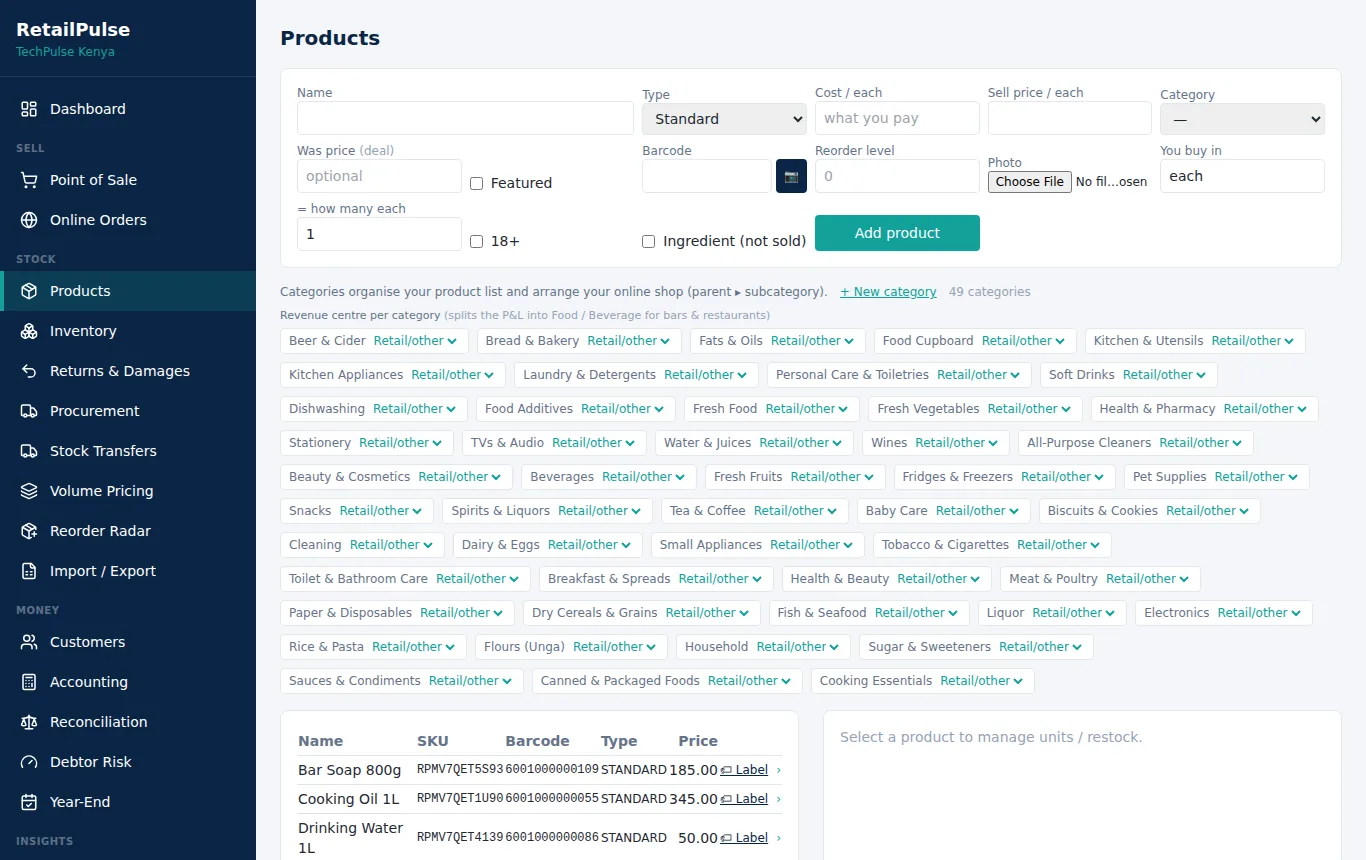
- SKU. Your own code for the product. Keep one SKU per product and pack size, so the stock you buy in cartons and sell in pieces still reconciles.
Set these up once, carefully, with your accountant. Getting them wrong on 2,000 products is painful to fix later.
Why stock is now part of the eTIMS decision
KRA’s stock management notice reminds all businesses invoicing through TIMS or eTIMS to keep records of stock received, bought, sold, moved between branches, returned, adjusted or otherwise disposed of, aligned with what they invoice. It cites section 23A(2)(b) of the Tax Procedures Act. KRA has not set an effective date and is holding consultative forums with businesses first.
The direction is clear, though: KRA wants to compare what you bought, what you sold and what is left. That is hard to do from an exercise book and a separate eTIMS app. It is easy when one system does the sale, the invoice and the stock movement together. We covered the deadlines and penalties in eTIMS 2026: the deadline, the penalties and your POS.
Supplying government? Read this
KRA and the National Treasury are linking eTIMS with IFMIS. According to Dawan Africa (31 August 2026), suppliers to government entities must generate valid eTIMS invoices for all supplies, and the details on the invoices they submit must match the eTIMS records exactly. One typo between your invoice and what you type into a payment request can hold up payment.
Where RetailPulse fits, and where it does not
If you are a consultant sending five invoices a month, you do not need us: the eTIMS Online portal is free and enough. RetailPulse is for businesses that sell goods across a counter every day: shops, supermarkets, chemists, hardware stores, wholesalers, bars and butcheries.
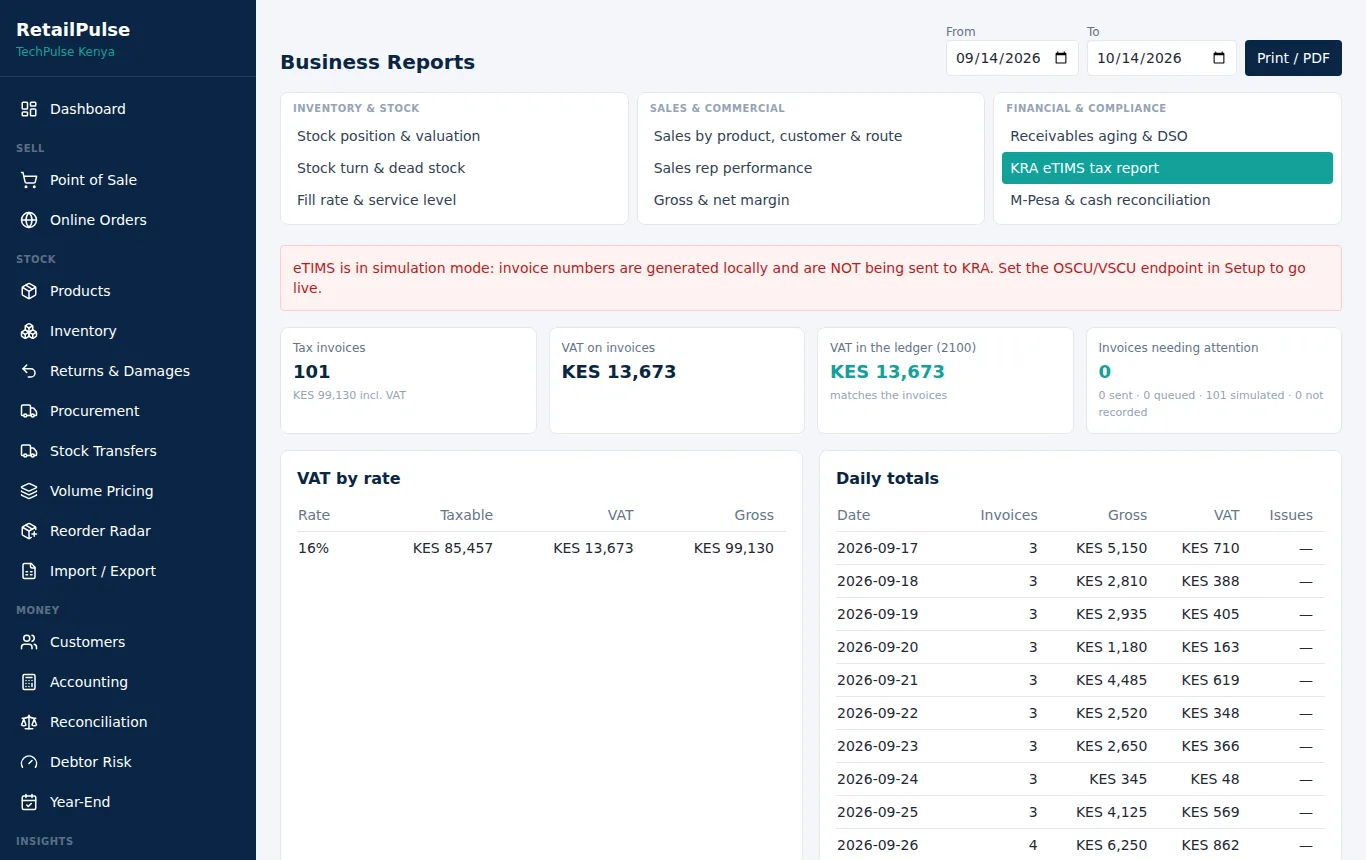
For them, it works like this. The cashier completes the sale; RetailPulse reduces stock, posts the accounts and transmits the eTIMS invoice through OSCU or VSCU, with the control unit invoice number and QR code on the receipt. If the internet drops, the invoice queues and retries. The eTIMS tax report shows what was sent, what is queued and what KRA has not confirmed, so the QR-code problem above never surprises you. You can run in simulation mode while your KRA onboarding is approved, then switch to live.
Plans start at KES 2,500 a month, billed yearly, with setup from KES 25,000 and no per-user fees. See RetailPulse pricing.
Not sure which eTIMS option fits?
Send us your type of business and roughly how many invoices you issue a month. We will tell you which eTIMS option fits, free, even if the answer is one that does not need our software.
OSCU, VSCU and eTIMS: questions people ask
What is OSCU in eTIMS?
OSCU is the Online Sales Control Unit. The control unit is hosted by KRA, and your POS or ERP connects to it over the internet through the KRA eTIMS API. KRA lists it for invoicing systems that operate online.
What is VSCU in eTIMS?
VSCU is the Virtual Sales Control Unit. It is a Java application that runs on your own side, on a server you control, and your invoicing system talks to it. KRA recommends it for businesses that issue large volumes of invoices in a short time and whose systems are not always online.
Which eTIMS option should a supermarket or wholesaler use?
A busy business that already uses a POS or ERP should integrate it through OSCU or VSCU, so the eTIMS invoice is issued inside each sale. VSCU suits very high volumes or unreliable internet; OSCU suits systems that are reliably online. Your integrator or KRA confirms the choice during onboarding.
What is a control unit invoice number?
It is the unique number the control unit gives every invoice it signs. KRA calls it the control unit invoice number. It appears on the receipt with the QR code, and credit notes must reference it.
Why does the QR code on my eTIMS receipt show no result?
According to KRA, the QR code only gives a result once the invoice has been transmitted to KRA. If your system was offline and the invoice is still queued, the code will not verify until it is sent.
What packaging unit and quantity unit do I use for services?
eTIMS integrators advise packaging unit NT (net, no packaging) and quantity unit U (pieces or items) for services such as a haircut, consultation or repair. Goods use their real units, such as a carton of 12.
Sources
- KRA, eTIMS Taxpayer Guidelines, 2024
- KRA, OSCU/VSCU step-by-step guide on how to sign up
- KRA, FAQs: electronic tax invoice
- KRA, Stock management functionality for electronic invoicing, September 2026
- ICPAK, KRA/ICPAK webinar: VAT automated assessments and stock management on eTIMS, 2 November 2026
- Dawan Africa, KRA announces integration of eTIMS with IFMIS, 31 August 2026
- Streamline Feed, KRA now matches tax returns against eTIMS and customs data, 7 September 2026
- Digitax, Which item class code should I use? and Which units should I use for services?