

Two things changed for every shop, bar and hotel that takes M-Pesa this year. Safaricom cut what merchants pay on a Buy Goods till, and KRA has started talking to Safaricom about M-Pesa issuing eTIMS invoices. One saves you money. The other could change how your sales reach KRA. Here is what is confirmed, what is not, and what to do in your books this month.
What did KRA say about M-Pesa and eTIMS?
On 29 October 2026, KRA told the National Assembly’s Finance Committee that it is in preliminary talks with Safaricom so that M-Pesa could generate eTIMS invoices for traders who are paid through tills and Paybills (The Star, 29 October 2026). The idea is simple: millions of small merchants already receive money through M-Pesa, so the invoice could be created where the payment happens.
Read that carefully. These are talks, not a rule. There is no start date, no technical standard and no announcement from Safaricom yet. Until there is, nothing changes: if you are required to issue eTIMS invoices, you still issue them from your own system.
The talks matter because KRA is already leaning on eTIMS data. Since 1 January 2026, the income and expenses in your tax return are checked against eTIMS invoices, withholding tax and customs records (Streamlinefeed), and in early September KRA told businesses to keep their stock records in TIMS and eTIMS (Tech-ish, 4 September 2026). Your 2026 return, filed next year, will be the first one tested against a full year of this data.
How much does Safaricom charge on a Buy Goods till in 2026?
From 7 August 2026, merchants pay nothing on Lipa na M-Pesa Buy Goods payments of KES 500 and below. Before, only payments up to KES 200 were free. Above KES 500 the fee is still 0.55% of the payment, capped at KES 200. Customers still pay nothing to pay a till, except at some fuel-station tills. At least four outlets reported the same figures (Tech-ish, Business.co.ke, TechAfrica News and TechMoran).
Here is what that means per sale. These are our own calculations from the published rate and cap, so check them against your till statement:
| Customer pays | Merchant fee before 7 Aug | Merchant fee now |
|---|---|---|
| KES 150 | KES 0 | KES 0 |
| KES 500 | about KES 2.75 | KES 0 |
| KES 1,000 | KES 5.50 | KES 5.50 |
| KES 10,000 | KES 55 | KES 55 |
| KES 50,000 | KES 200 (cap) | KES 200 (cap) |
Safaricom also cut what a business pays to send money out of a till on the same date. The first KES 100 is free, and the highest charge for paying a mobile number fell from KES 108 to KES 54 (Tech-ish, Business.co.ke). Outlets disagree on some of the middle bands, so use your own statement for exact figures.
For a kiosk or a busy minimart where most sales are under KES 500, this is a real saving. For a wholesaler or a hotel where most payments are large, the bill is much the same as before. Either way, the fee is a business expense, and that is where most shops go wrong.
Is there VAT on M-Pesa merchant fees after the Finance Act 2026?
The Finance Act 2026 was signed on 23 June 2026 and most of it took effect on 1 July. It made fees that payment service providers charge for payment processing, settlement, merchant acquiring, gateway and aggregation services subject to VAT at 16%, instead of exempt (EY Global Tax News). The tax is on the fee, not on the amount the customer pays. The proposal to put VAT on ordinary mobile money transfer fees was dropped before the Act passed (Mjengo Hub).
What nobody has confirmed yet is whether a Lipa na M-Pesa till or Paybill fee counts as “merchant acquiring or aggregation”. Card acquirers and payment gateways clearly do. Some websites say VAT now applies to all mobile money fees; we have not found KRA or Safaricom saying so. If you are VAT-registered, ask your accountant, and only claim input VAT on a fee when you hold the provider’s eTIMS invoice for it.
Why small fees cause big reconciliation problems
Take a shop that sells KES 120,000 a day through its till. If the average payment is KES 1,000, that is 120 payments and about KES 660 in fees a day, or roughly KES 20,000 a month. When the fees are not recorded, three things go wrong:
- The till never balances. Sales say KES 120,000; the M-Pesa statement says less. Someone spends an evening looking for the difference.
- Profit is overstated. KES 20,000 a month of real costs is missing from the P&L, so you pay tax on money you never had.
- Your return and KRA’s data drift apart. With returns now checked against eTIMS and bank data, small unexplained gaps are exactly what an automated check flags.
What to do this month
- Open last month’s till statement and add up the charges. Compare the total with what your books show as M-Pesa and bank charges. If your books show nothing, that is your first fix.
- Record fees as an expense, every day. A sale paid by M-Pesa is two entries: the sale, and the fee that Safaricom kept. Card payments work the same way with the bank’s commission.
- Reconcile the till statement weekly, not at year end. Match each receipt to a sale and each charge line to a fee.
- Keep issuing eTIMS invoices from your own system. Do not wait for M-Pesa to do it; that is still only talks.
- Clear old penalties before 31 December. KRA’s 2026 tax amnesty waives penalties and interest on tax owed up to 31 December 2025, if the principal is paid by 31 December 2026, in one go or through an iTax payment plan (KRA).
How RetailPulse handles M-Pesa and bank charges
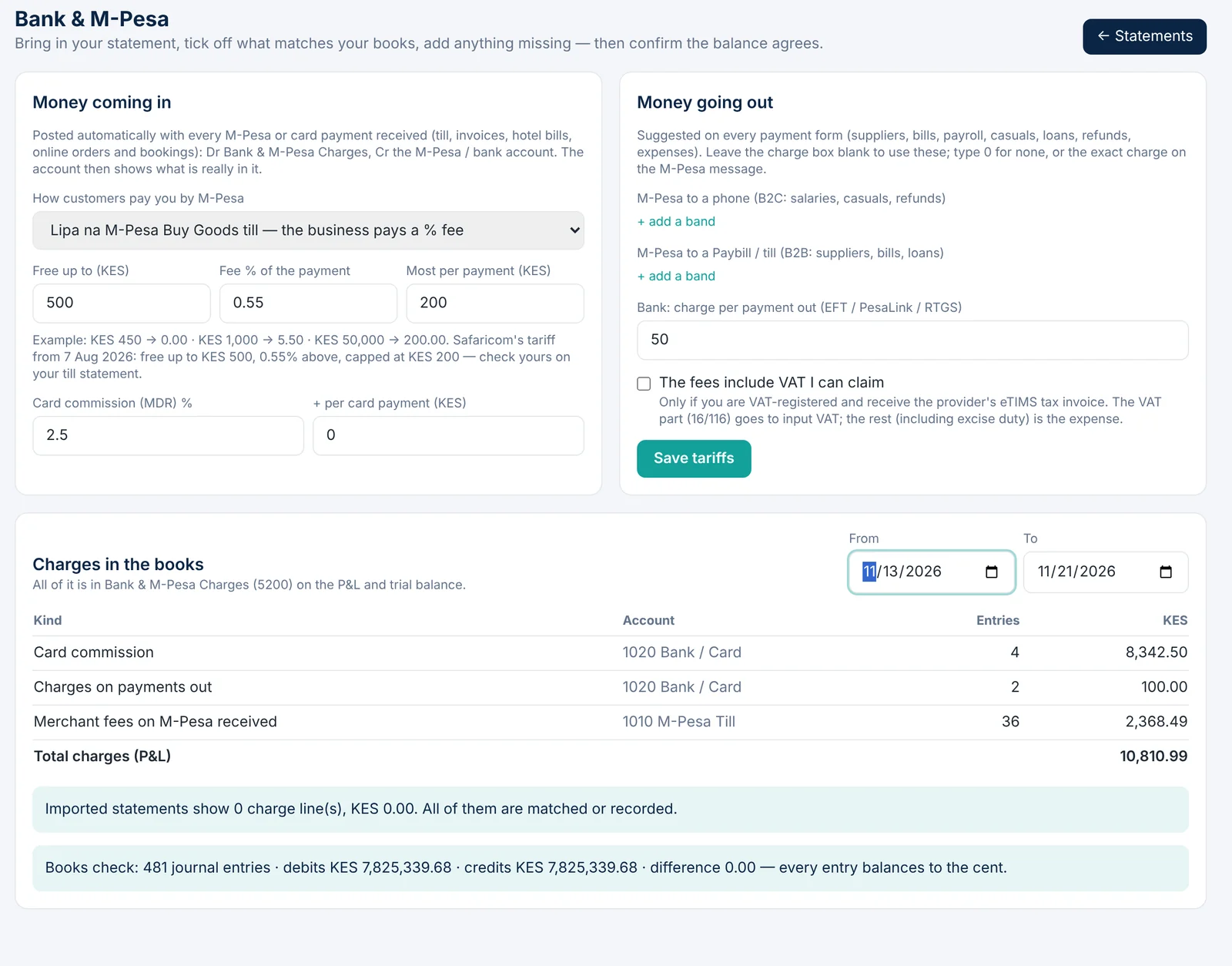
We built this into RetailPulse because our own test shops kept failing the same reconciliation. You set the tariffs once under Bank & M-Pesa: the Buy Goods rule (free up to KES 500, 0.55%, capped at KES 200, all editable), Paybill bands if you pay them, card commission, and the usual charge for money you send out. From then on:
- every M-Pesa or card payment received, at the till, on an invoice, on a hotel folio or from the online shop, posts its fee to Bank & M-Pesa Charges on the same day;
- every payment out suggests the right charge: leave it blank for the tariff, type 0 for none, or type the exact figure;
- voiding a sale reverses its fee, so nothing is left hanging;
- when you import the bank or M-Pesa statement, receipts shown net of their fee still match, and charge lines match the fee already recorded, so nothing is counted twice;
- if you are VAT-registered and hold the provider’s eTIMS invoice, you can switch on the VAT split so 16/116 of the fee goes to input VAT.
Each till sale also carries its own KRA eTIMS invoice, issued from RetailPulse. See the accounting and bank reconciliation tools or the M-PESA POS for the full picture.
See your M-Pesa fees in your books
Book a free demo and we will set up the Buy Goods tariff, run a day of sales and show the charges report and the books check on your own numbers.
This is a plain guide, not tax advice. Tariffs and tax rules change; confirm your own case with Safaricom, KRA or your accountant.
Questions people ask
How much does Safaricom charge merchants on a Buy Goods till in 2026?
From 7 August 2026, Buy Goods payments of KES 500 and below are free for the merchant. Above that the fee is 0.55% of the payment, capped at KES 200. Customers pay nothing to pay a till, except at some fuel-station tills.
Will M-Pesa issue eTIMS invoices for my shop?
Not yet. On 29 October 2026 KRA told Parliament it is in preliminary talks with Safaricom about M-Pesa generating eTIMS invoices for merchants paid through tills and Paybills. There is no start date, so keep issuing eTIMS invoices from your own system.
Is there VAT on M-Pesa till fees?
The Finance Act 2026 made fees for payment processing, merchant acquiring, gateway and aggregation services subject to 16% VAT from 1 July 2026. It is not yet confirmed whether M-Pesa till and Paybill fees fall in that group. Ask your accountant, and only claim input VAT when you hold the provider’s eTIMS invoice.
How do I record M-Pesa charges in my books?
Record each fee as an expense, separate from the sale: the sale goes to sales, and the fee Safaricom keeps goes to an account such as Bank and M-Pesa Charges. Then reconcile the till statement so every receipt and every charge line is matched.
When does the KRA tax amnesty end?
The 2026 tax amnesty closes on 31 December 2026. It waives penalties and interest on tax owed up to 31 December 2025 if the principal tax is paid by that date, in one payment or through an iTax payment plan.
Sources
- The Star, “How KRA plans to ease tax compliance for MSMEs”, 29 October 2026
- Tech-ish, M-Pesa Pochi and Buy Goods tariff cuts, 1 August 2026
- Business.co.ke, Safaricom cuts M-Pesa business fees by up to 50% from August 2026
- TechAfrica News, Safaricom lowers M-Pesa fees under PATA MORE, 4 August 2026
- TechMoran, Safaricom cuts M-Pesa fees for small businesses, 19 October 2026
- EY Global Tax News, Kenya enacts Finance Act 2026
- Mjengo Hub, Finance Bill 2026 passes with VAT on mobile money transfers dropped
- Streamlinefeed, KRA now matches tax returns against eTIMS and customs data
- Tech-ish, KRA orders businesses to keep stock records in TIMS and eTIMS, 4 September 2026
- KRA, 2026 Tax Amnesty Programme at a glance